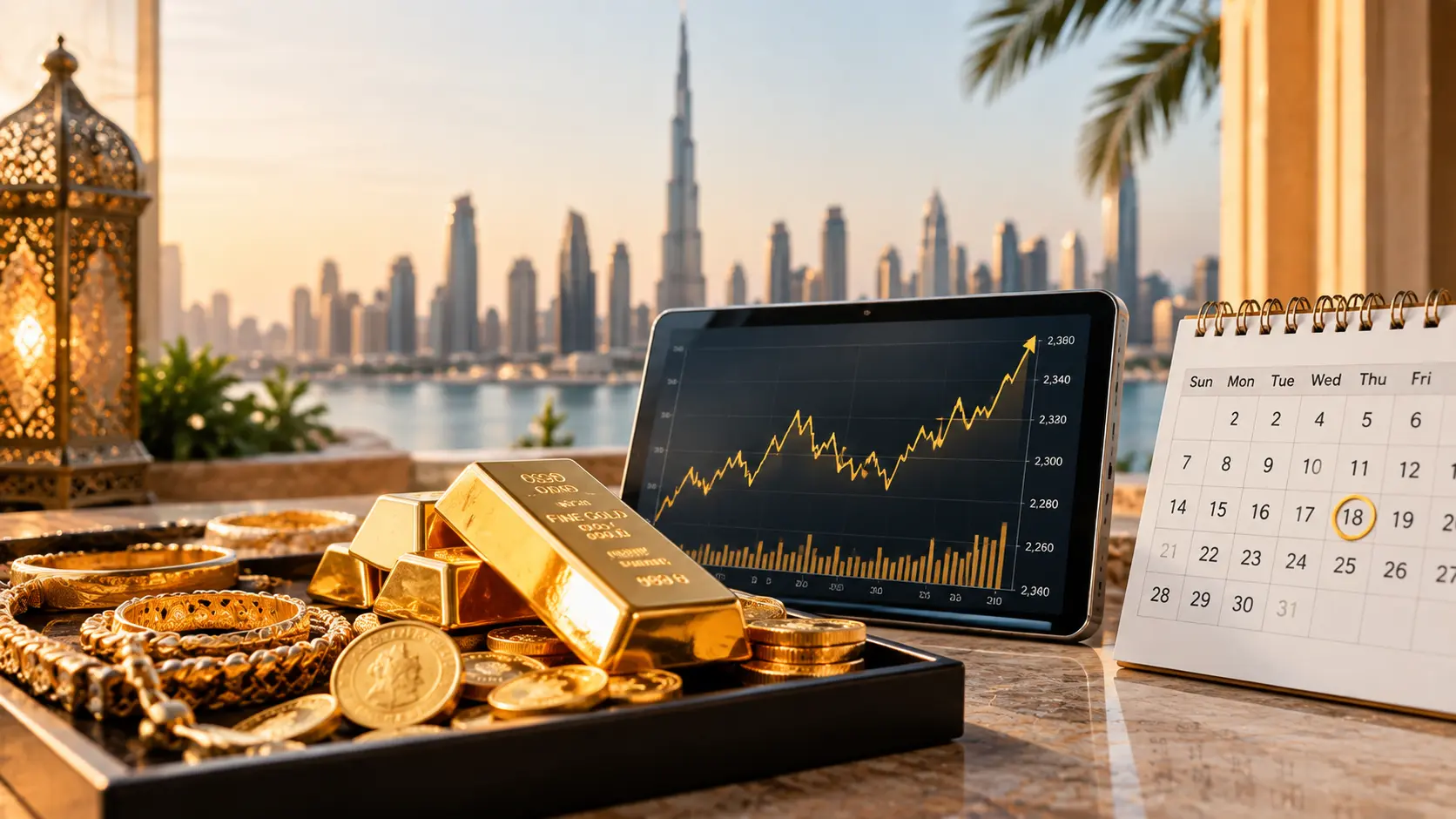
why gold rate changes daily? Search for why gold prices move and you will mostly find two kinds of article. One is written for British buyers and talks about sterling. The other is written for Indian buyers and spends half its length on import duty and GST.
Neither describes how it works here. The UAE has no import duty on gold, investment-grade bullion is zero-rated for VAT under Federal Tax Authority rules, and the dirham has been fixed to the US dollar since 1997. That combination makes the Dubai gold rate behave differently from almost anywhere else, and it makes some of the most commonly repeated explanations simply wrong for this market.
This article explains where the daily rate actually comes from, what moves it, and why the number on a souk board, the number on a trading chart and the number you pay for a bar are three different things.
We are a bullion dealer in Deira, so this is the explanation we give across the counter.
Gold does not have one price. It has three.
Almost every argument about a “wrong” gold price comes from comparing two of these figures to each other.
The international spot price. This is the wholesale price of unallocated gold delivered in London, quoted in US dollars per troy ounce and written XAU/USD. It moves continuously while markets are open. This is the number you see on a trading chart, and it is not a price any retail buyer pays.
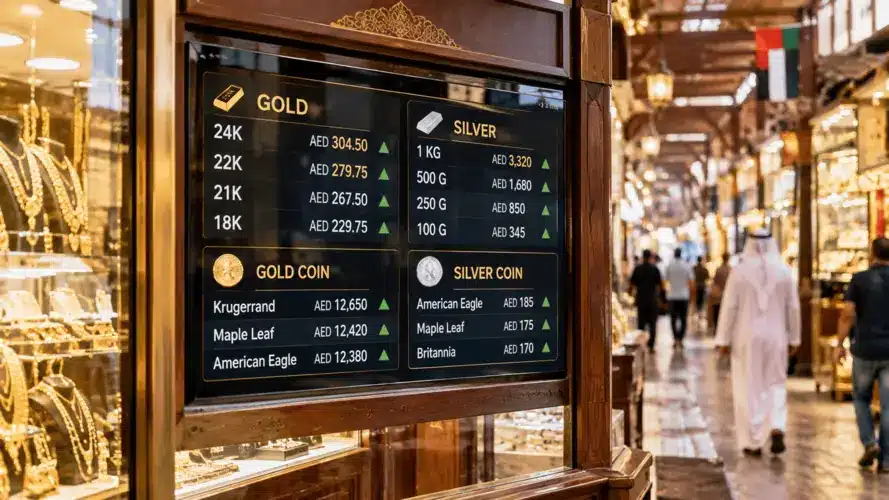
The Dubai retail reference rate. The Dubai Jewellery Group, the industry body representing the emirate’s gold trade, publishes a reference retail rate for the UAE market. It is shown on official display boards at the Gold Souk and republished by local media including Gulf News and Khaleej Times. It is a retail reference for the gold content of a sale, and it carries a small margin over the wholesale price to cover the real cost of getting physical metal into a shop and to protect sellers against intraday swings.

why gold rate changes daily
The boards quote several purities side by side — 24K, 22K, 21K and 18K — because most retail gold sold in the UAE is jewellery rather than bullion. Investment bars are 24K, so the 24K line is the one relevant to a bullion buyer.
The price of an actual product. A specific 10 gram bar from a specific refinery has a specific price: gold content at the current rate, plus that refinery’s premium for minting, assay certification and packaging. Two bars of identical weight and purity can be priced differently, and neither shop is wrong.
| International spot price | Dubai retail reference rate | Price of an actual bar | |
|---|---|---|---|
| Quoted in | US dollars per troy ounce | Dirhams per gram | Dirhams, per product |
| Set by | The global market, continuously | Dubai Jewellery Group, from the international price | The dealer, from the rate plus premium |
| How often it changes | Second by second while markets are open | Published per trading day, revised when the market moves materially | With the rate, and when premiums change |
| Includes a margin? | No — wholesale | Yes, a small one | Yes — the refinery premium |
| Who uses it | Traders, refiners, banks | Jewellers and shoppers comparing shops | Anyone actually buying bullion |
| Can you buy at this price? | No | Not exactly — it excludes premium | Yes |
When someone says a dealer’s price “doesn’t match the gold price”, they are almost always comparing a finished product to a wholesale spot quote. Those two numbers were never meant to be equal.
Where the daily rate actually comes from
The market barely closes
Gold trades across three overlapping sessions — Asia, then London, then New York — which together cover almost the entire working day. Liquidity is deepest in London, where the physical bullion market has been centred for centuries, and the sharpest moves often come when New York opens and US economic data lands.
Because trading is close to continuous, the spot price is not something set once. It is being discovered every second there is a bid and an offer.
But there is still an official benchmark
A continuously moving price is awkward for contracts, valuations and large physical settlements. So the market also has a formal benchmark.
The LBMA Gold Price is set twice each London business day, in an electronic auction operated by ICE Benchmark Administration. The auctions run at 10:30 and 15:00 London time, and the results are published as the LBMA Gold Price AM and PM. The price forms in US dollars per troy ounce. Silver has a single auction at 12:00 London time.
This replaced the older London Gold Fix in March 2015, when the telephone-based process was retired in favour of a transparent, auditable electronic auction.
Why this matters to you. Refiners, banks and large dealers reference these benchmarks. When a wholesale contract or a refinery quote refers to “the fix”, this is what it means.
From London to a Deira shop window
The chain is shorter than most people assume.
The benchmark is quoted per troy ounce, which is 31.1035 grams — not the 28.35 grams of an ordinary ounce, a confusion that causes real errors. Divide by 31.1035 for a per-gram figure in dollars, multiply by the fixed exchange rate for dirhams, and you have the gold content value per gram in AED. Everything after that is margin and premium.
Why the dirham makes the UAE different
This is the part most articles get wrong for this market, and it is worth being precise about.
The UAE dirham has been pegged to the US dollar at 3.6725 since 1997. The peg has held through the financial crisis, the oil price collapse of 2014, the pandemic and every interest rate cycle since.
The practical consequence: the AED gold price has one variable, not two.
| 🇦🇪 UAE | 🇮🇳 India | |
|---|---|---|
| Currency against the dollar | Pegged at 3.6725 | Floating |
| Variables moving the local gold price | One — the dollar gold price | Two — the dollar gold price and the rupee |
| Import duty on gold | None | Applies, and has been revised repeatedly |
| Tax on investment bullion | Zero-rated for VAT at 99% purity and above | GST applies |
| Local reference rate | One national rate, published by the Dubai Jewellery Group | Set by regional associations, varies by city |
| How closely the local price tracks spot | Very closely | Less closely — duty, tax and currency all intervene |
In India, the local gold price moves when the dollar gold price moves and when the rupee moves against the dollar. A rupee that weakens by 2% lifts the local gold price by roughly 2% even if gold itself did not budge. Indian buyers have to watch both.
In the UAE, that second variable does not exist. If the dirham rate of gold rose today, it is because gold rose in dollars. Nothing else.

why gold rate changes daily uae
That is why Dubai gold prices track the international market so closely, and it is one of several reasons Dubai has a reputation for tight pricing. We look at that comparison properly in is gold cheaper in Dubai.
The six forces that actually move the price
Here is what is happening underneath on the days the rate jumps.
1. Real interest rates
The single most useful thing to understand. Gold pays no interest and no dividend, so holding it has an opportunity cost: the yield you gave up by not holding something that does pay. When inflation-adjusted interest rates fall, that cost shrinks and gold usually becomes more attractive. When real rates rise, the opposite.
This is why gold often reacts more to a central bank’s tone about future rates than to an inflation number itself.
2. The US dollar
Gold is priced in dollars, so the dollar’s strength affects the price arithmetically before anything else happens. A weaker dollar tends to lift the dollar price of gold even when nothing about gold has changed, because it takes more dollars to buy the same metal.
For UAE buyers this is the one global factor that passes through completely, since the dirham moves with the dollar by design.
3. Central bank buying
Central banks have been substantial net buyers of gold in recent years, adding to reserves. These are large, slow, price-insensitive purchases that absorb supply from the market. They rarely cause a single day’s move on their own, but they shape the floor the price trades above.
The World Gold Council publishes reported gold reserves by country, compiled from IMF data, if you want to see who has been buying.
4. Investor and ETF flows
Gold-backed exchange traded funds must hold physical metal against the shares they issue. When money flows in, the fund buys gold. When investors sell, it sells. These flows are reported and watched closely, and they transmit sentiment into the physical market quickly.
The quarterly Gold Demand Trends report breaks this down by category — jewellery, bar and coin, ETFs and central banks — and is the standard reference for where physical demand is actually coming from.

What time does the gold rate change in Dubai?
5. Geopolitical and financial stress
Gold is one of the few assets with no counterparty — nobody has to stay solvent for it to keep its value. In periods of conflict, banking stress or currency uncertainty, that property attracts money.
The reaction is often faster and larger than the eventual outcome justifies, which is why sharp risk-driven rallies frequently give back part of the move.
6. Physical demand and the calendar
Jewellery and bar demand is seasonal, and two of the world’s largest gold-buying populations are heavily represented in the Gulf. Wedding seasons in India, Eid, Diwali, and Chinese New Year all concentrate physical buying into particular weeks.
In the UAE this is visible on the ground before it is visible in the price: the souk gets busier. Seasonal demand rarely drives the global price on its own — investment flows are much larger — but it affects local availability and how quickly popular sizes sell out.
The important caveat: on most days several of these forces are acting at once, in opposite directions. That is why gold can barely move on a day of dramatic headlines and jump on a quiet one. Anyone who tells you a single factor explains a particular day’s move is simplifying.
| Force | What to watch | Gold typically rises when | How fast it shows up |
|---|---|---|---|
| Real interest rates | Central bank policy and the tone of its guidance | Inflation-adjusted rates fall | Minutes, on the announcement |
| The US dollar | The dollar against other major currencies | The dollar weakens | Immediately, arithmetically |
| Central bank buying | Reported monthly and quarterly reserve changes | Official buying is sustained | Months — it sets a floor, not a day’s move |
| Investor and ETF flows | Reported fund holdings | Money flows into gold funds | Days to weeks |
| Geopolitical stress | Conflict, banking stress, currency crises | Uncertainty rises sharply | Hours, often overshooting |
| Physical demand | Wedding and festival calendars in Asia and the Gulf | Seasonal buying concentrates | Weeks, and mostly local |
What time does the gold rate change in Dubai?
A practical question that almost no guide answers properly for this timezone.
The spot price moves throughout the trading day. The two London benchmark auctions are the fixed points, and converting them to local time gives you the moments worth knowing:
| Benchmark | London time | Dubai (GST), UK summer | Dubai (GST), UK winter |
|---|---|---|---|
| LBMA Gold Price AM | 10:30 | 13:30 | 14:30 |
| LBMA Gold Price PM | 15:00 | 18:00 | 19:00 |
| LBMA Silver Price | 12:00 | 15:00 | 16:00 |
The UAE does not observe daylight saving, so these local times shift by an hour twice a year when the UK changes clocks. The same applies to New York. Across a full day, the three trading sessions look like this in local time:
| Session | Approximate GST window | What tends to drive moves |
|---|---|---|
| Asia | 03:00 – 12:00 | Physical demand from China and India, overnight positioning |
| London | 11:00 – 20:00 | The deepest liquidity in physical gold; both benchmark auctions |
| New York | 16:30 – 01:00 | US economic data, Federal Reserve announcements, futures activity |
| London + New York overlap | 16:30 – 20:00 | Busiest hours of the day — sharpest intraday moves |
| Quietest stretch | 01:00 – 03:00 | Thin volume between the New York close and Asia opening properly |
The busiest window for UAE buyers is that overlap, when London and New York are both open. US economic releases and Federal Reserve announcements land in this window, and it is where the sharpest intraday moves usually happen.
The detail most people miss — Dubai wakes up first
Dubai is three hours ahead of London in the UK summer and four hours ahead in the UK winter. That gap has a consequence worth understanding.
When the Gold Souk opens for the day, the most recent official LBMA benchmark is the previous afternoon’s PM auction. The AM auction has not happened yet and will not happen until early afternoon Dubai time. So the rate on a souk board first thing in the morning is anchored to yesterday’s London close, adjusted for whatever the Asian session has done overnight.
This is one reason the rate can appear to move noticeably in the early afternoon here. It is not the shops changing their minds. It is London opening.
In practice: if you are making a significant purchase, ask for the rate at the moment of the transaction rather than relying on a figure you saw earlier in the day. A board you looked at in the morning may not show the same number by evening.
The current gold and silver rates we trade on are displayed live at the top of every page on this site, and the price of each individual bar is shown on its own product page.
Why your dealer’s price moved but the headline rate did not
Three reasons, and all of them are normal.
The premium changed, not the gold. Premiums are set by supply and demand for manufactured bars, not for gold itself. If a refinery’s 10 gram bars are in short supply, the premium on that product rises while the gold price is flat. Small bars are more sensitive to this than large ones.
You are looking at a bid and being quoted an ask. Every market has two prices: what a buyer will pay and what a seller will accept. Charts usually show a mid-market or spot figure. A retail quote is an ask. The difference is not a hidden charge, it is how a two-sided market works.
The product is not the metal. A designed or limited-edition bar is priced partly as a collectible. Its price can move for reasons that have nothing to do with the gold market.
What this means if you are buying
Do not try to time the daily move. Over the period most people hold physical gold, the premium paid and the brand chosen usually matter more to the outcome than which day the purchase was made. Daily timing is a much harder game than it looks, and the people who play it professionally are not using a souk board to do it.
Compare premiums, not rates. The gold rate is effectively the same for everyone. The premium is not, and it is the only part you can actually shop around on.
Ask for the price in two parts. Gold content and premium, stated separately. This is the most useful question you can ask any seller, and it makes comparison possible.
Ask whether the rate can be locked. For larger purchases, many dealers will fix the rate at the moment you commit rather than at the moment the paperwork completes. If gold has been volatile that week, this matters.
That first point deserves more than a line, and the popular answers to it contradict each other more than most buyers realise. We look at whether you should try to time your purchase, and what is genuinely timeable in this market, in a separate guide.
What this means if you are selling
The same mechanics run in reverse, with one addition.
Nobody buys back at the price they sold. The gap between what a dealer pays and what a dealer charges is how the business runs, and a dealer who claimed otherwise would be misleading you. What you can reasonably ask is how that gap is calculated, and whether the sealed packaging and original assay card change the offer. They usually do.
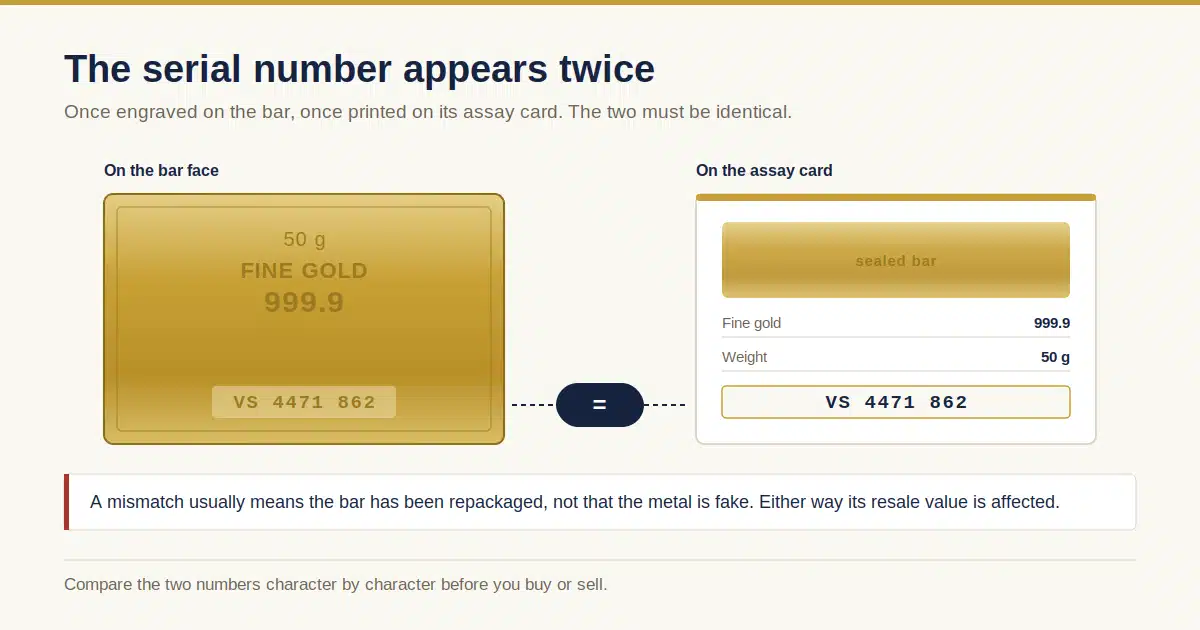
A bar still sealed in its assay card with a matching serial number needs no re-verification, so it is worth more to the next buyer than the same bar loose in a drawer.
Four things people get wrong
“Dubai sets its own gold price.” It does not. Dubai publishes a reference retail rate derived from the international price. No city sets the price of gold.
“The rate is fixed for the day.” The published reference rate is a reference, revised when the market moves. The underlying spot price never stopped moving at all.
“A troy ounce is an ounce.” A troy ounce is 31.1035 grams; a standard ounce is about 28.35. Using the wrong one produces a roughly 10% error, which is more than most annual moves in the gold price.
“Gold always rises when there is bad news.” Often, not always. When investors need cash urgently they sell whatever they can sell, including gold. Sharp market crashes have sometimes pushed gold down before pushing it up.
Disclaimer. This article explains how gold pricing works. It is general information, not financial or investment advice, and nothing here is a forecast. Benchmark times and methodology reflect LBMA and ICE Benchmark Administration arrangements as at the date above and may change. Gold prices can fall as well as rise.
Live gold and silver rates are shown at the top of every page on this site.
If you want to see what we hold and what each bar costs, browse our gold bars, or get in touch — questions about pricing are welcome.
Frequently Asked Questions
Why does the gold rate change every day?
Because gold trades continuously on a global market and its price responds to real interest rates, the strength of the US dollar, central bank buying, investor flows, geopolitical conditions and physical demand. These factors change daily, so the price does too.
Who sets the gold rate in Dubai?
Nobody sets it locally in the sense of choosing it. The international price is discovered on the global market and formalised twice a day through the LBMA Gold Price auctions in London. The Dubai Jewellery Group then publishes a reference retail rate for the UAE market, derived from that international price and displayed on official boards in the Gold Souk.
How many times a day does the gold price change?
The spot price changes continuously while markets are open, potentially many times a minute during active periods. The formal LBMA benchmark is set twice each London business day. The Dubai retail reference rate is published for the trading day and revised when the international price moves materially.
What time does the gold rate change in the UAE?
It moves throughout the day. The fixed points are the two London auctions at 10:30 and 15:00 London time, which fall at 13:30 and 18:00 Gulf Standard Time during British Summer Time and an hour later in the UK winter. The most active window locally is roughly 16:30 to 20:00 GST.
Why does the rate seem to change in the afternoon in Dubai?
Because London opens after Dubai does. When shops here open in the morning, the most recent official benchmark is the previous afternoon's London auction. The first London auction of the day does not take place until early afternoon Gulf Standard Time.
Why is the gold price different at different shops in Dubai?
The gold content is priced from the same rate everywhere. What differs is the premium, and for jewellery the making charge. Two shops quoting different totals for similar items are usually differing on the premium, not on the gold.
Does the exchange rate affect gold prices in the UAE?
Not meaningfully. The dirham has been pegged to the US dollar at 3.6725 since 1997, so currency movement does not add or remove volatility the way it does in countries with a floating currency. If the dirham price of gold changed, the dollar price of gold changed.
What is the difference between the spot price and the Dubai gold rate?
The spot price is the wholesale international price for unallocated gold in London, quoted per troy ounce in US dollars. The Dubai retail rate is a local reference for the gold content of retail sales, quoted per gram in dirhams, and carries a small margin over the wholesale price.
Should I wait for the gold rate to drop before buying?
That is a market timing decision and nobody can tell you reliably what the price will do next. What can be said is that for most private buyers the premium paid and the format chosen have a larger effect on the eventual outcome than the day of purchase. If you are buying, focus on the parts you can control.