
We sell gold bars for a living, so the commercially convenient thing to write would be that now is always a good time to buy. Instead, here is what we actually tell people across the counter: the question “when the best time to buy gold in Dubai?” contains two very different questions, and almost every guide online answers only the one that cannot be answered.
The advice you will find online contradicts itself
Before going further, it is worth looking at what the popular guides actually say. We read through the articles currently ranking for this question, and the picture is not encouraging.
| Month | One source says | Another source says |
|---|---|---|
| January | Gold’s strongest month, averaging roughly +5% over the last twenty years | A post-holiday demand lull, and one of the better windows to buy |
| March | The biggest price drops of the year, among the best times to buy in Dubai | February to May is the weakest stretch of the year for buying gold in Dubai |
| September | Gold’s strongest month, positive in about 64% of years across five decades | Gold’s worst month, with around 90% of Septembers closing negative over ten years |
These are not nuanced disagreements about interpretation. A strong month is a poor month to buy, so the January pair cannot both be useful advice. The March pair comes from two guides written specifically about Dubai, describing the same weeks in opposite terms. The September figures are both published as historical fact, and they cannot both describe the same data.
Even the academic literature does not settle it. A peer-reviewed study by Baur, published in Research in International Business and Finance in 2013, found that September and November were the only months with positive and statistically significant gold price changes between 1980 and 2010 — the so-called autumn effect. An independent analysis published in 2025, using a permutation test on monthly returns from 2000 to 2025, found September to be statistically unremarkable.
And one more thing that should give you pause. Three of the Dubai-focused guides we read contain near-identical sentences about analysing gold prices since 1975. None of them cites a source for that analysis. It has been copied between sites.
None of this means seasonality is entirely imaginary. Physical gold demand genuinely is seasonal, and the reasons are real: Indian wedding and festival buying, Chinese New Year, Western jewellery demand before Christmas. What it means is that the effect is small, unreliable in any individual year, and nowhere near strong enough to tell you what to do with your own money in the month you happen to be reading this.
You are actually asking two questions
Separating them is the most useful thing in this article.
Question one: will gold be cheaper next month than it is today?
Nobody knows. Not us, not the guides, not the analysts quoted in them. If anyone could answer this reliably they would not be publishing it in a blog post.
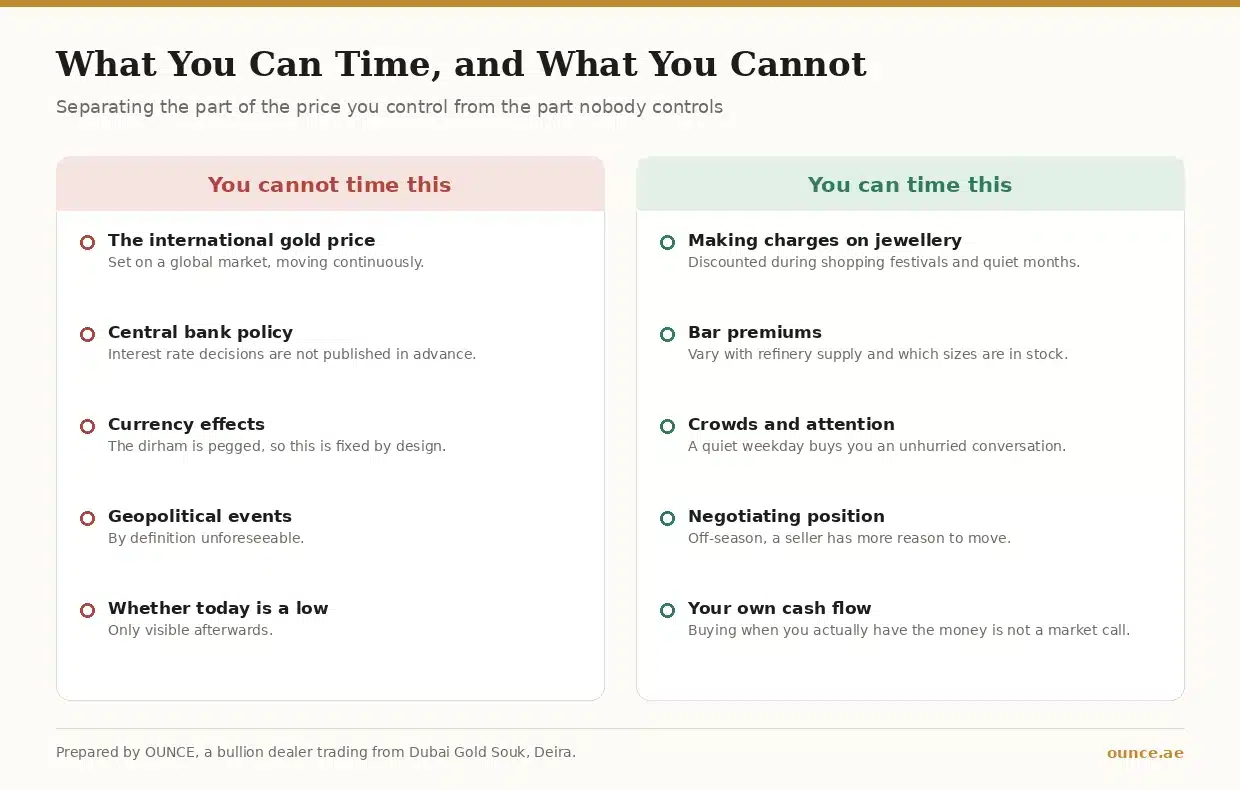
Question two: given that I am going to buy gold, when and how should I do it to pay the least for the same metal?
This one has real answers. They are less exciting, but they are yours to control.
best month to buy gold
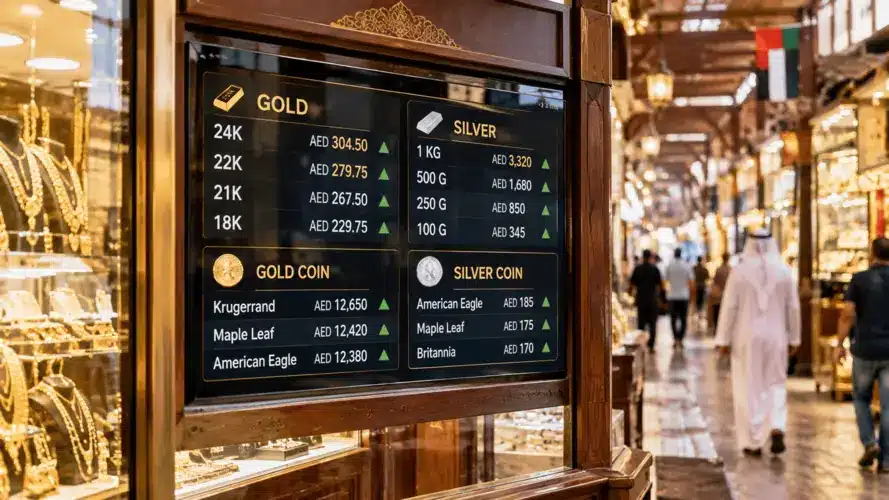
The gold rate is effectively identical at every dealer in the city, because it comes from the same international market. If you want to understand where it comes from and why it moves, we explain that in detail in why the gold rate changes daily.
Everything above that rate — the premium, the making charge, what a seller is willing to do on a slow Tuesday — is where the differences actually live. That is the part worth timing.
Why “buy in March” cannot be good advice in Dubai
Here is a structural problem with fixed-month advice that the guides repeating it seem not to have noticed. Dubai’s local gold demand is driven substantially by two communities whose buying calendars move every year.
Ramadan and Eid shift roughly eleven days earlier each year against the Gregorian calendar, because the Islamic calendar is lunar. A demand peak that falls in March one year falls in February a few years later, and in December a decade after that.
Akshaya Tritiya, Dhanteras and Diwali — the days on which buying gold is considered auspicious across the large Indian community in the UAE — move with the Hindu calendar and land on different Gregorian dates each year.
So even if local demand did move the price in a predictable way, the months it moved would not stay put. Any rule of the form “March is cheap in Dubai” is describing a pattern that cannot hold still long enough to be a rule.
What does stay roughly fixed is the retail calendar: the Dubai Shopping Festival in January, Dubai Summer Surprises across July and August, and the tourist high season from roughly October to April. Those are the things a buyer in Dubai can actually plan around, and Gulf News has covered how UAE gold buyers use them.
What genuinely changes through the year in Dubai
Making charges, if you are buying jewellery
This is the largest timeable cost in the whole market, and it applies only to jewellery. A making charge is what you pay for the craftsmanship on top of the gold content. It can run from around 10 to 50 dirhams per gram depending on the piece, and unlike the gold itself, most of it is not recoverable when you sell.
Making charges are genuinely discounted during shopping festivals and in quieter months, and they are negotiable in a way the gold rate never is. If you are buying jewellery, this is the number to focus on — not the month.

best day to buy gold
Premiums, if you are buying bars
Bullion works differently, and this is where our answer diverges from every tourist guide. A bar premium covers refining, minting, assay certification and packaging. It does not respond to the Dubai shopping calendar. It responds to refinery supply and which sizes are actually in stock.
Premiums on a particular size can tighten when a refinery has a production run coming through, and widen when a popular format is scarce. Small bars are more sensitive to this than large ones, because the fixed cost of making a bar is spread over less metal.
That means the useful question for a bullion buyer is not “is this a good month?” but “is this size currently well supplied?” It is a question you can simply ask a dealer, and the answer changes far more often than the season does.
Crowds, and what they cost you
This one is underrated.
A quiet weekday afternoon in the souk is a completely different buying experience from a Saturday evening in high season. Not because the rate changes, but because attention does. A seller with three people waiting behind you has little reason to spend twenty minutes explaining premiums, checking stock in other sizes, or discussing buy-back terms.
If you want an unhurried conversation with someone who will actually answer questions, go when the market is quiet. That single choice is worth more to most first-time buyers than any seasonal theory.
Your own cash flow
Buying when you genuinely have the money, rather than stretching to catch a perceived dip, is not a market timing decision. It is the one piece of timing entirely within your control, and it removes the risk of being forced to sell at a bad moment later.
Time of day — what actually happens
A narrower question, and one with a concrete answer.
Dubai runs ahead of London, so when the souk opens in the morning, the most recent official international benchmark is the previous afternoon’s. The local reference rate published for the day reflects that, adjusted for overnight trading in Asia. London opens in the early afternoon Dubai time, which is when the international price tends to become more active.
What this does not mean. Some guides advise buying in the morning “before prices are adjusted upward.” That advice quietly assumes prices always move up during the day, which is simply not true — they move both ways. Morning trading is calmer, not systematically cheaper.
What it does mean. If you are buying a large amount, ask for the rate at the moment of the transaction, and ask whether it can be fixed while the paperwork completes. On a volatile day that matters more than which hour you walked in.
Three ways people approach it
We see all three. None is obviously right.
Buying the whole amount at once is simple and gets it done. The trade-off is that your entire position depends on one day’s price.
Splitting the budget across several purchases spreads that risk across different prices. The trade-off is real and rarely mentioned: several small bars cost more per gram in premium than one larger bar. You are paying a premium to reduce price risk, and whether that is worth it depends on how much the difference is — ask for both quotes before deciding.
Waiting for an event — a festival, a dip, a promotion — can work. The trade-off is that waiting is itself a position. Holding cash while gold rises costs you just as surely as buying before a fall does, and it is much easier to overlook.
Which of these fits you depends on your circumstances, not on a rule that applies to everybody.
When not to buy
Clearer answers live on this side of the question.
Not when you are rushed. Airport gates, closing time, a seller who needs a decision now. The checks that protect you take a few minutes and cannot be done under pressure.
Not with money you will need soon. Physical gold is liquid, but selling under time pressure means accepting whatever the buy-back is that day.
Not on the basis of a price forecast you read somewhere. Including anything in this article, which contains none.
Not when you cannot compare. If a seller will not break the price into gold value and premium, you have no basis for judging whether the timing is good or bad, because you cannot see what you are paying above the metal.
Four things people get wrong about timing
“Prices are lower in the summer.” Visitor numbers are lower in the summer, which can make sellers more flexible on making charges and premiums. The gold price itself is set globally and does not know it is July in Dubai.
“Buy on the weekend, markets are closed.” International markets do close over the weekend, so the rate is static. That cuts both ways: you are buying at a price fixed by Friday’s close, which may be above or below where Monday opens. It is not a discount.

best time to buy gold in dubai
“Wait for the dip.” Dips are only identifiable afterwards. What looks like a dip in the moment is often the middle of a move, and the people who wait for a clear signal usually buy after it.
“Gold always goes up over time, so timing doesn’t matter.” The first half is a claim about the future that nobody can guarantee, and gold has had long flat and falling periods. The second half is closer to true for long holdings, but it is an argument for not obsessing over timing, not an argument for ignoring the premium you pay.
What we would actually suggest
Not advice about the market. Just the practical version.
Decide what you want first — bars or coins, and which size — because premium varies more between formats than between months. Then ask two dealers for the same quote broken into gold value and premium, on the same day. That comparison tells you something real. A seasonal theory does not.
If you are buying jewellery, the shopping festivals are worth planning around, because making charges genuinely move. If you are buying bars, ask which sizes are well supplied right now, and buy the one with the best premium among the sizes that suit you.
And if none of that resolves it, buying a smaller amount now and the rest later is a perfectly reasonable way to stop agonising over a question that has no clean answer.
You can see what we currently hold across weights and refiners in our gold bar collection. If you are still deciding where to buy rather than when, our guide to where to buy gold bars in Dubai compares the options.
Disclaimer. This article is general information about how gold pricing works in Dubai. It is not financial or investment advice, contains no price forecast, and should not be read as a recommendation to buy or to wait. Gold prices can fall as well as rise. Seasonal patterns described in published research are historical tendencies, not predictions. If you are making a significant purchase, take independent advice appropriate to your circumstances.
Frequently Asked Questions
What is the best month to buy gold in Dubai?
There is no reliable best month. The seasonal claims published online contradict each other directly — one Dubai guide calls March the cheapest month while another calls February to May the weakest time to buy. Physical demand is seasonal, but the effect on price is small and unreliable in any individual year.
Is gold cheaper during the Dubai Shopping Festival?
The gold itself is not, because its price is set on the international market. What can be cheaper is the making charge on jewellery, which is often discounted during the festival. For investment bars the effect is minimal, since bar premiums track refinery supply rather than the retail calendar.
What is the best day of the week to buy gold in Dubai?
For price, no day is reliably better. For the quality of the transaction, a quiet weekday is usually better than a busy weekend, because you get more of the seller's attention and more room to ask questions.
Should I wait for the gold price to drop before buying?
That is a market timing decision and nobody can tell you reliably what the price will do next. What can be said is that the premium you pay and the format you choose usually affect the outcome of a long-term holding more than the day you bought.
Is it better to buy gold in the morning or evening in Dubai?
Morning trading is calmer because London has not opened yet, but calmer is not the same as cheaper — prices move in both directions. For a large purchase, what matters more is asking for the rate at the moment of the transaction rather than relying on a figure from earlier in the day.
Does Ramadan or Diwali affect gold prices in Dubai?
They affect local demand, footfall and sometimes stock availability in popular sizes. Because these dates move against the Gregorian calendar each year, they cannot produce a stable "buy in month X" rule, which is one reason fixed-month advice about Dubai does not hold up.
Is seasonality in gold prices real?
There is genuine academic work finding seasonal effects — Baur's 2013 study identified statistically significant positive returns in September and November between 1980 and 2010. Other analyses using different periods and methods find no significant effect. Treat it as a weak tendency, not a rule.
Does buying in smaller amounts over time cost more?
Usually yes, in premium terms. Several small bars carry a higher premium per gram than one larger bar of the same total weight. Whether that extra cost is worth the reduced exposure to a single day's price is a personal judgement — ask for both quotes and compare the actual difference.