
At first glance, the comparison between 24K Gold vs 22K Gold seems simple. One is purer, the other is slightly less pure. But once you move beyond the numbers, the difference becomes much more practical — and much more important for buyers.
A lot of people assume higher karat automatically means “better” gold. In reality, the best option depends entirely on how the gold will be used. The gold bar stored in a vault and the bracelet worn every day are solving two completely different problems. One prioritizes purity and investment value. The other needs strength, durability, and resistance to daily wear.
That’s why experienced gold buyers rarely look at karat alone. They look at purity, resale value, craftsmanship, long-term wear, and even regional market preferences before deciding what actually makes sense.
Understanding gold purity becomes much easier once you see how different karat levels compare side by side. A detailed What Is a Gold Purity guide can help you quickly understand the difference between 24K, 22K, 18K, and other common gold purities.
Gold Karat Explained: What Does Karat Actually Mean?
The karat system measures the amount of pure gold inside a piece of gold. Pure gold is classified as 24 karats, meaning all 24 parts are gold with almost no additional metals mixed in.
Once other metals are added, the karat number decreases. Those added metals — usually copper, silver, zinc, or nickel — are known as alloys.
This is where many buyers misunderstand gold. Lower karat does not necessarily mean “bad” gold. In many cases, alloy metals improve the gold by making it stronger, more durable, and more practical for jewelry.
That distinction is the foundation of the entire pure gold vs alloy gold conversation.
| Gold Type | Purity | Hallmark | Typical Use |
|---|---|---|---|
| 24K Gold | 99.9% Pure | 999 Gold | Bullion bars, coins, investment |
| 22K Gold | 91.6% Pure | 916 Gold | Jewelry and ornaments |
| 18K Gold | 75% Pure | 750 Gold | Luxury and gemstone jewelry |
24K vs 22K Gold: The Real Difference
The biggest difference between 24K and 22K gold is not simply purity. It is how the gold behaves in real life.
24K gold purity is approximately 99.9%, making it the purest commercially available gold in global markets. It contains almost no alloy metals, which gives it high intrinsic value and strong appeal for investors.
22K gold contains around 91.6% pure gold and 8.4% alloy metals. That small percentage changes the gold dramatically. It becomes stronger, harder, and more suitable for wearable jewelry.
In practical terms:
- 24K gold is designed for storing value.
- 22K gold is designed for wearing value.
That’s why gold bars and bullion coins are usually made in 24K, while necklaces, bangles, and wedding jewelry are commonly produced in 22K.
24K Gold: Why Investors Prefer Pure Gold
When people picture “pure gold,” they are usually imagining 24 karat gold. It has a rich yellow tone that immediately looks different from lower-karat jewelry.
Because it contains almost no additional metals, 24K gold is internationally recognized as investment-grade gold. This is also why it is commonly labeled as 999 gold.
Investors prefer 24K bullion for one major reason: transparency. The value is directly tied to global spot gold prices, making pricing easier to understand and resale simpler across international markets.
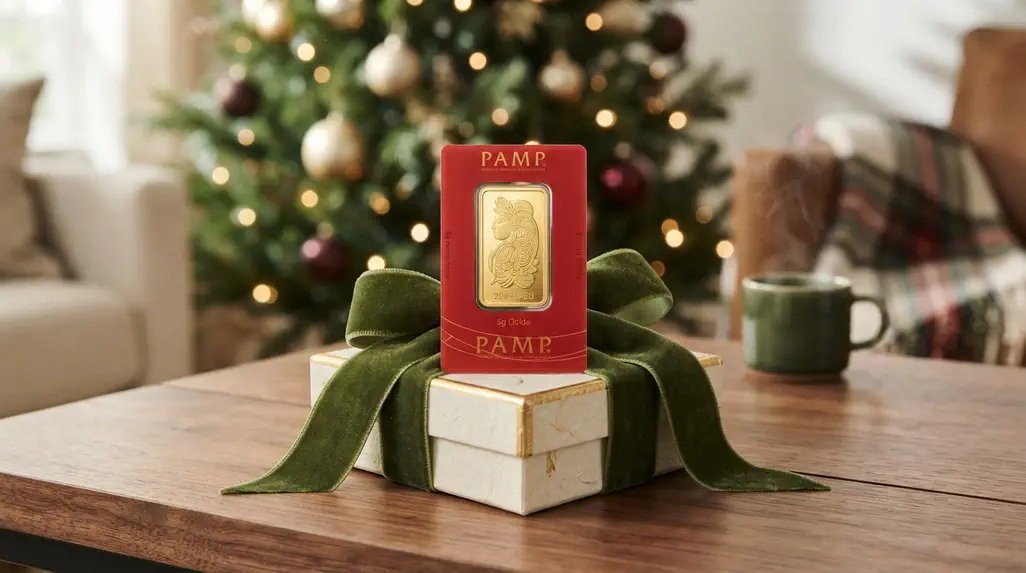
Gold bars produced by major refiners such as PAMP Gold Bars, Valcambi Goldbars, BTC Gold bars, Emirates Gold, or the Royal Mint are typically manufactured in 24K purity for this exact reason.
But purity comes with a tradeoff many first-time buyers underestimate.
24K Gold Softness Is Real
24K gold softness is not just a technical detail. You can actually feel the difference when handling pure gold jewelry.
A pure 24K ring scratches faster than most people expect. Thin pieces can slowly bend over time, especially when worn daily. Even small impacts can leave marks more easily compared to alloyed gold.
This softness explains why most jewelers do not recommend pure gold for heavily used jewelry like rings or bracelets.
Ironically, the very thing that makes 24K gold valuable — purity — is also what makes it fragile.
Common Uses of 24K Gold
- Investment-grade gold bars
- Bullion coins
- Central bank reserves
- Long-term wealth storage
- High-purity collectible gold products
22K Gold Meaning: Why It Dominates Jewelry Markets
22K gold meaning is simple: 22 parts pure gold and 2 parts alloy metals out of 24 total parts.
That equals approximately 91.6% gold purity, which is why 22K gold is commonly stamped as 916 gold.
Although it contains slightly less pure gold than 24K, 22K solves one major problem: durability.
The added alloy metals strengthen the structure without dramatically changing the appearance of the gold. It still looks luxurious and rich, but becomes much more practical for daily wear.
This balance is exactly why 22 karat jewelry remains dominant in markets like Dubai, India, Saudi Arabia, and across much of Asia.
In fact, many experienced buyers intentionally choose 22K over 24K for jewelry because they know softer gold becomes difficult to maintain over time.
Why Jewelers Prefer 22K Gold
Jewelry makers often prefer 22K gold because it allows for more secure craftsmanship and detailed designs.
Intricate bridal necklaces, bangles, and handcrafted ornaments hold their structure more effectively in 22K compared to pure gold.
It is also more suitable for gemstone settings. Softer gold may struggle to securely hold stones over long periods of wear.
Why 22K Gold Is Harder Than 24K Gold
One of the most common questions buyers ask is why 22K gold feels significantly stronger despite containing less gold.
The answer comes down to gold alloy composition.
Pure gold has a naturally soft molecular structure. When metals like copper or silver are added, the structure becomes harder and more resistant to pressure, bending, and scratches.
This added hardness changes how the jewelry performs in everyday life.
For example, a pure 24K bracelet may show visible wear relatively quickly if worn daily. A similar 22K bracelet will usually maintain its shape and finish much longer.
The durability of 22K gold is one of the main reasons it became the standard for traditional fine jewelry across multiple cultures.

Price Difference Between 22K and 24K Gold
The price difference between 22K and 24K gold is primarily driven by purity.
Since 24K contains more pure gold, it generally costs more per gram. Global gold pricing is based on pure gold value, so higher purity directly increases intrinsic worth.
How much cheaper is 22K than 24K?
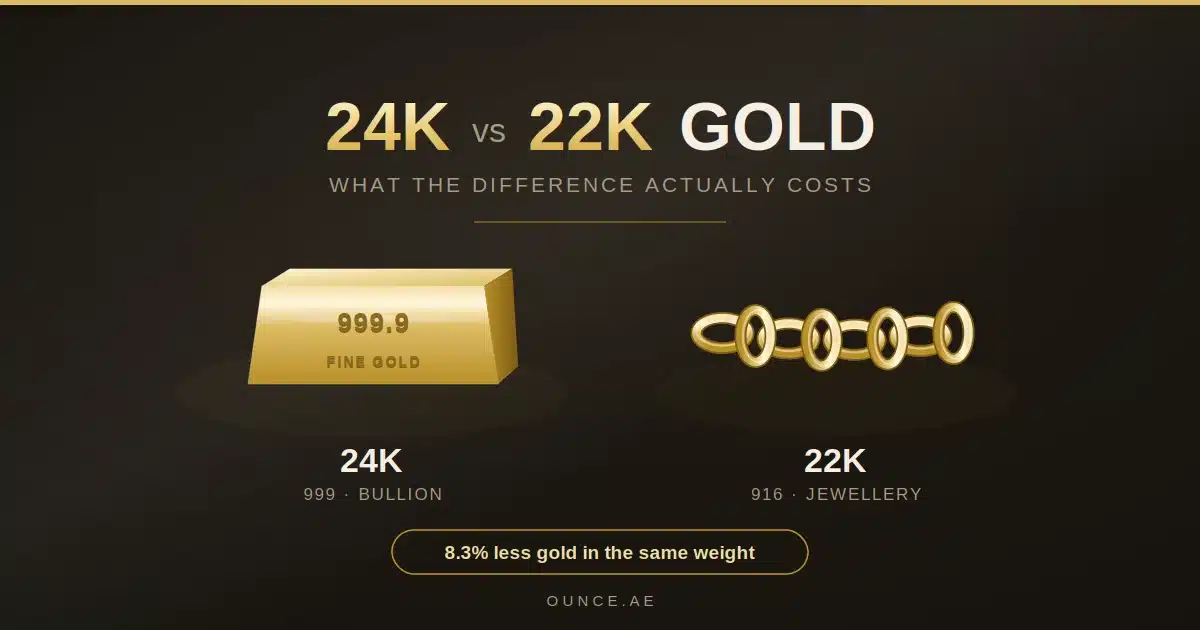
In metal content, 8.3%.
The maths is simple enough to do yourself. Divide the karat by 24 to get the gold fraction, then multiply by today’s rate:
Gold fraction = karat ÷ 24
Metal value per gram = today’s 24K rate × gold fraction
Take a 10-gram piece and call the 24K rate R per gram:
| Purity | Calculation | Metal value | vs 24K |
|---|---|---|---|
| 24K (999) | 10 × R × 0.999 | 9.99R | — |
| 22K (916) | 10 × R × 0.916 | 9.16R | −8.3% |
So a 10g 22K chain holds 9.16 grams of actual gold, against 9.99 grams in a 10g 24K bar. At today’s gold rate in Dubai, that is the entire metal-value gap — 8.3%, not the 10% or 15% figures that circulate.
The formula works at any rate, on any day, for any karat.
However, real-world jewelry pricing is more complicated than many buyers realize.
Rate boards across the UAE quote 24K, 22K, 21K and 18K side by side, all derived from the same international price. If you have wondered why those figures change every day, we cover the mechanism in a separate guide.
A handcrafted 22K necklace may cost significantly more overall than a simple 24K gold coin because jewelry pricing also includes:
- Making charges
- Craftsmanship
- Design complexity
- Retail markup
- Stone settings
- Brand premiums
This is especially noticeable in markets like Dubai, where elaborate bridal jewelry can carry substantial labor costs despite lower purity than bullion.
| Feature | 24K Gold | 22K Gold |
|---|---|---|
| Gold Purity | 99.9% | 91.6% |
| Hallmark | 999 | 916 |
| Durability | Lower | Higher |
| Best Use | Investment | Jewelry |
| Scratch Resistance | Low | Better |
| Investment Appeal | Very High | Moderate |
999 Gold vs 916 Gold
The comparison between 999 gold vs 916 gold simply reflects two different purity standards.
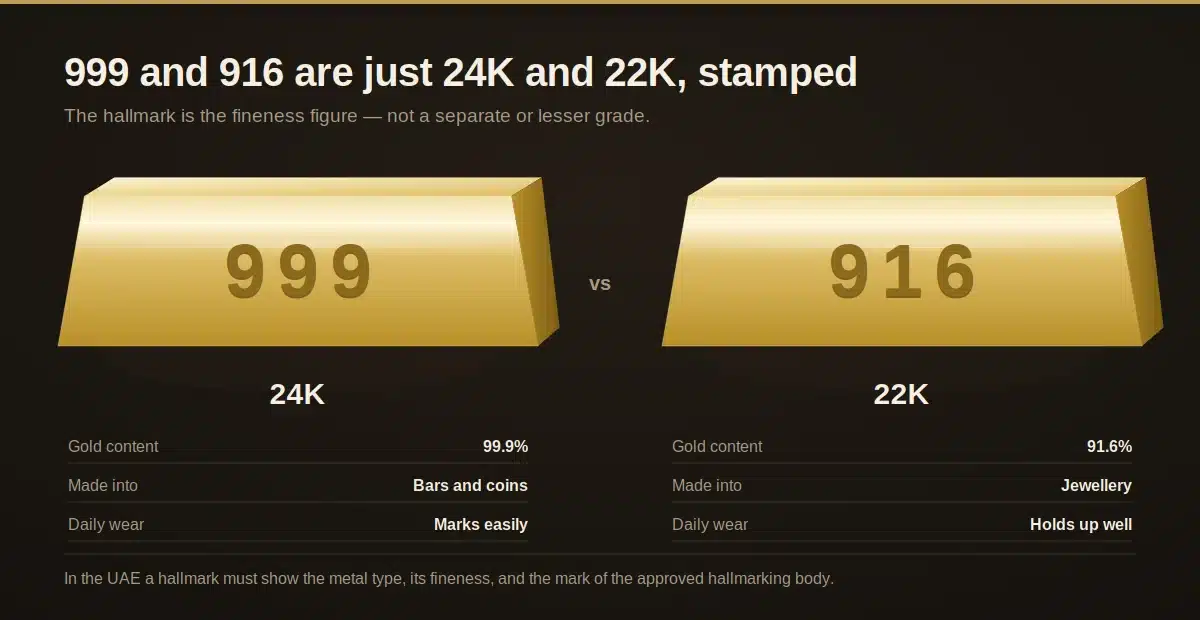
999 gold refers to 99.9% purity, equivalent to 24K gold. This purity level is commonly used for bullion gold purity and investment products.
916 gold refers to 91.6% purity, equivalent to 22K gold. It is widely used in jewelry because it combines high gold content with better wear resistance.
In markets such as the UAE and India, many buyers actually search for “916 gold” more often than “22K gold” because the hallmark itself has become associated with trusted jewelry quality.
For serious investors and wholesale buyers, understanding How to Buy Gold Bullion in Bulk is important before making large purchases. Buying bullion in higher quantities can affect pricing, premiums, storage options, and even resale flexibility.
Are 999 and 916 Hallmarks Legally Guaranteed in the UAE?
Yes. Gold sold in the UAE is not simply trusted — it is regulated. Hallmarking of precious metals is governed by Federal Law No. 11 of 2015, which applies across all seven emirates. Under the law a hallmark must carry three things: a mark denoting the type of precious metal, its standard of fineness, and the distinctive mark of the approved hallmarking body. The recognised fineness levels themselves are set in the Executive Regulations.
In Dubai the authority is the Dubai Central Laboratory Department, part of Dubai Municipality and accredited by the UAE Ministry of Economy as the national reference laboratory for precious metals and stones. DCL tests for compliance and inspects retailers. The standard non-destructive test is XRF — X-ray fluorescence — which reads the alloy composition without damaging the piece.
Three checks before you pay:
- Find the stamp. 999 or 916. Usually inside a ring band, on a clasp, or on the back of a pendant.
- Ask the invoice to state the purity, not just the weight and total price.
- Ask the retailer to test it. Reputable shops have an XRF tester and will use it in front of you. Reluctance is itself an answer.
For bullion the equivalent is the assay card: a sealed certificate stating fineness, weight and a serial number that matches the bar.
Which Is Better for Investment?
For investment purposes, 24K gold is usually the better choice.
Higher purity means easier international resale, stronger alignment with global gold prices, and lower confusion around valuation.
This is why most investors prefer:
- Gold bars
- Bullion coins
- Certified refinery products
These products are easier to trade internationally and usually carry lower premiums compared to jewelry.
Investors focused on wealth preservation typically prioritize bullion over ornaments because jewelry resale values can be affected by making charges and design depreciation.
Many investors comparing precious metals also look at Gold vs Silver: Which Is Better in 2026? before deciding where to put their money. While gold is often seen as a stability asset, silver can offer different opportunities depending on market conditions and industrial demand.
Which Is Better for Jewelry?
For jewelry, 22K gold is often the smarter and more balanced choice.
It still delivers high gold purity while offering far better structural durability than pure gold. That extra strength matters for jewelry exposed to constant movement and friction.
A 22K necklace or bracelet can maintain its appearance much longer under regular wear. This is especially important for bridal jewelry, heirloom pieces, and traditional ornaments intended to last for years.
That’s why many experienced buyers intentionally avoid pure 24K jewelry despite its higher purity.
| Question | Best Choice |
|---|---|
| Highest purity | 24K Gold |
| Best for investment | 24K Gold |
| Best for jewelry | 22K Gold |
| Better durability | 22K Gold |
| Most valuable per gram | 24K Gold |
| Best for daily wear | 22K Gold |
Conclusion
The discussion around 24K vs 22K Gold is not really about which type is universally better. It is about choosing the right gold for the right purpose.
If your priority is maximum purity, bullion value, and long-term investment potential, 24K gold remains the preferred option. But if you want gold that balances luxury with real-world durability, 22K gold is usually the more practical choice for jewelry.
The smartest buyers understand that purity alone does not define value. Wearability, resale behavior, craftsmanship, and long-term use matter too. Once you understand the real difference between 24K and 22K gold, choosing the right option becomes far easier — and far more financially sensible.
Buy Goldbars in Seizes:
Frequently Asked Questions
Is 24K gold better than 22K gold?
24K gold is purer than 22K gold, but that does not automatically make it better for every purpose. 24K is ideal for bullion and investment, while 22K is generally better for jewelry because it is more durable.
Why is 22K gold more durable than 24K gold?
22K gold contains alloy metals such as copper and silver, which strengthen the gold structure and improve resistance to scratches and bending. Pure 24K gold is naturally softer.
What is the difference between 999 gold and 916 gold?
999 gold refers to 24K gold with 99.9% purity, commonly used in bullion products. 916 gold refers to 22K gold with 91.6% purity, commonly used in jewelry.
Is 916 gold the same as 22K?
Yes. 916 is the hallmark stamp for 22K gold, indicating 91.6% purity. Both terms describe the same standard — 916 is simply the fineness figure stamped on the piece under UAE hallmarking rules.
How much cheaper is 22K gold than 24K?
In metal content, 8.3% cheaper at the same weight and rate. A 10-gram 22K piece holds 9.16 grams of pure gold against 9.99 grams in 10 grams of 24K. The shop price difference can be larger because jewellery also carries a making charge that bullion does not.