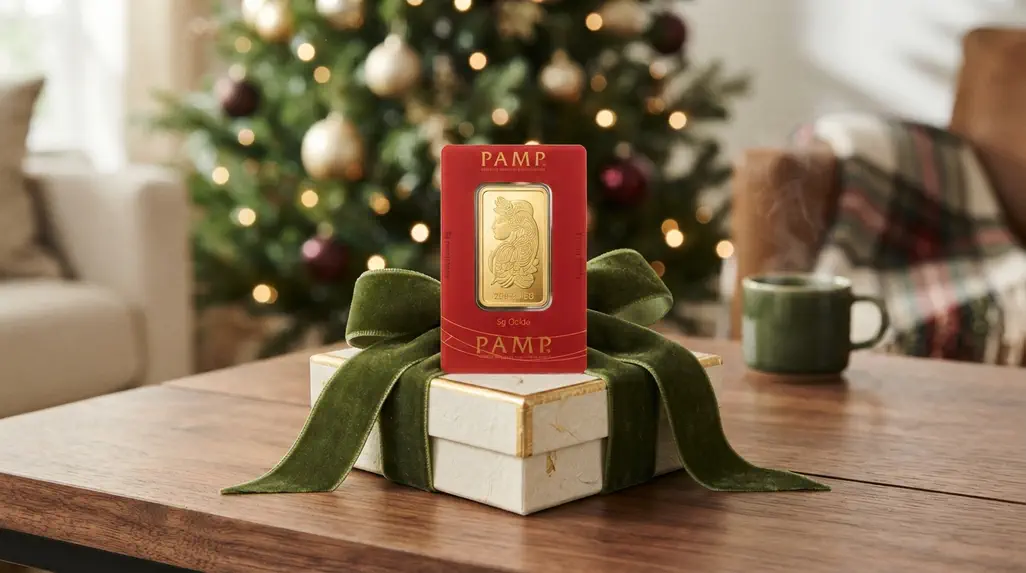

PAMP Llama 1g Gold Bar
816.79 AED
PAMP Lunar Legends Three Goats 1 oz Gold Bar
13,886.62 AED
1 Gram Sprite® Gold Bar .9999 Fine in TEP
928.79 AED
PAMP 50g Cast Gold Bar
21,439.44 AED
PAMP 5 Grams 2026 Year Of The Horse
2,343.94 AEDWe confirm and lock the rate. Gold moves throughout the trading day, so we fix your price at the moment you commit, not when the shipment leaves. We quote the metal value and our premium as two separate numbers, so you can see exactly what you are paying for.
Insured delivery, cash at the door. Your bars travel sealed and insured to your address in Oman. You can settle by bank transfer or online payment in advance, or pay cash on delivery — the courier hands you the sealed bars and the assay card, you check the serial number against the invoice, and only then does the money move.
That last option matters more than it sounds. The single biggest hesitation in buying bullion remotely is sending a large sum to a dealer you have never met. Cash on delivery removes that hesitation entirely: nothing leaves your hands before the gold is in them.
What to check before you accept the delivery
Take thirty seconds at the door:
- The assay card seal is unbroken
- The serial number on the bar matches the card
- Both match the invoice you were sent
- The weight and fineness are stamped as ordered
If anything does not match, do not accept the parcel. Our guide to checking a gold bar serial number explains what each refiner’s verification system actually proves.
Oman’s gold already comes from the UAE
The import data is worth looking at closely, because it reframes the whole question of where to buy.
According to figures from Oman’s National Centre for Statistics and Information, in the first five months of 2024 the country imported about 8,443 kilograms of gold worth RO 176,591,960 — a 41 percent rise on the same period a year earlier, when imports ran to 5,675 kilograms worth RO 125.1 million.
The origin breakdown is the striking part:
- United Arab Emirates — RO 170,395,964
- Hong Kong — RO 3,173,485
- Türkiye — RO 1,420,125
- Bahrain — RO 680,688
- Russia — RO 314,615
One country accounts for about 96 percent of the value. Everything else is a rounding error by comparison.
What that means in practice: when a shop in Muttrah or Seeb sells you gold, the metal very likely entered Oman through the UAE, and every intermediary it passed through on the way added something to the price you pay. Buying nearer the source removes links from that chain rather than adding one.
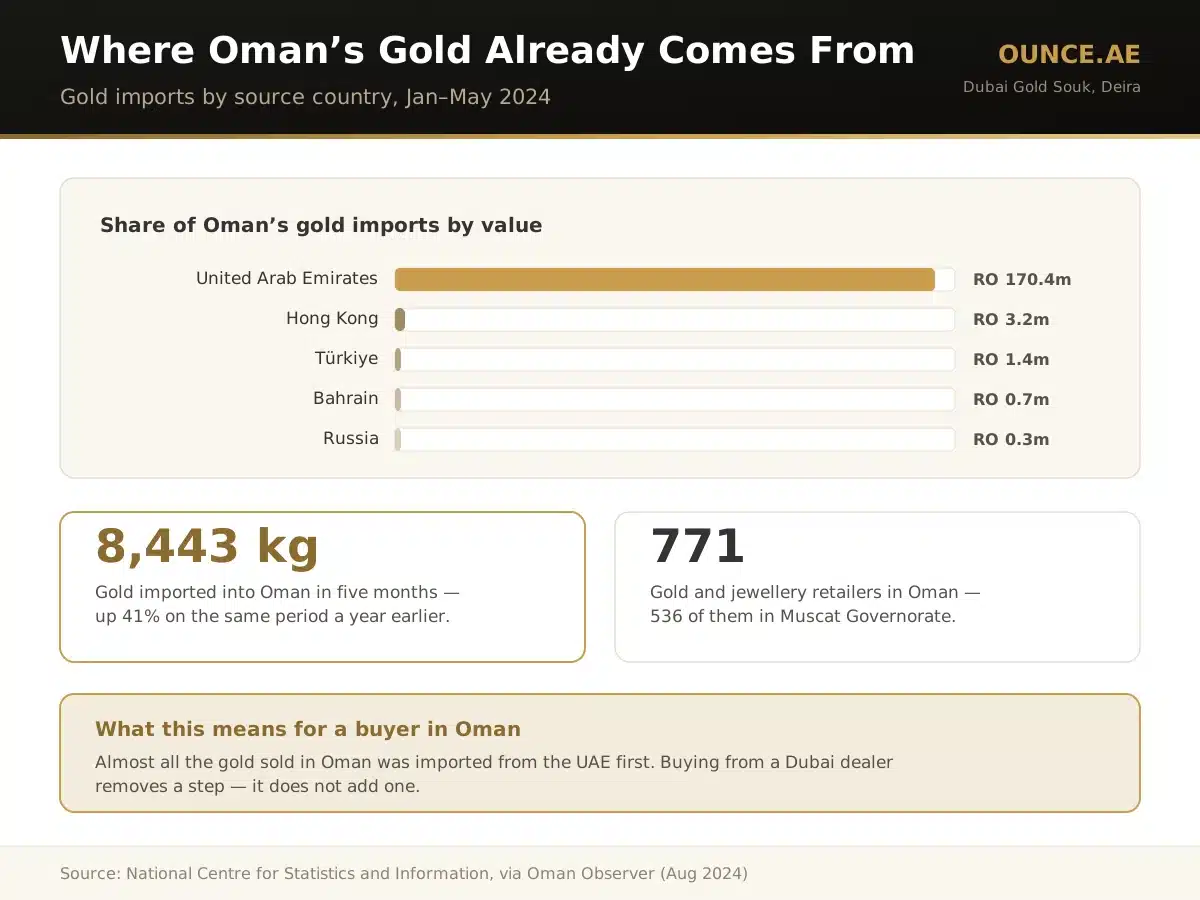
Where Oman’s gold imports come from — 96% from the UAE
What Oman’s 771 gold shops actually sell
an had around 820 gold and jewellery retail establishments in 2025, up from 785 the year before. That sounds like abundant choice for a bullion buyer. For jewellery it is. For investment bars, it mostly isn’t.
The overwhelming majority sell jewellery, and the Omani market leans heavily toward 21-karat — the Oman Observer notes that “in Oman, 21K gold is among the most popular choices for jewellery purchases.” Pricing works the way it works across the Gulf jewellery trade: the daily rate per gram multiplied by the weight, plus a making charge for design and craftsmanship. The same paper advises shoppers to compare making charges between stores, “as these are often negotiable, particularly for larger purchases” — which tells you they are substantial enough to be worth negotiating.
That is a perfectly reasonable way to buy a necklace. It is an expensive way to buy an asset, because the making charge is not returned when you sell. You paid for craftsmanship; the next buyer prices the metal.
A sealed investment bar is priced differently. The metal value and the dealer premium are two separate, visible numbers, and the bar is resold on its metal content. Nothing is lost to workmanship.
Where to look in Oman for actual bullion
Muttrah Souq on the Muscat corniche is the best-known gold market in the country and worth visiting on its own terms. But it is a jewellery souq. Expect 21K and 22K sets, bridal gold and coins rather than a range of sealed bars from named refiners.
A small number of Omani dealers and banks do sell investment bars. If you want bullion without leaving the country, those are the places to ask — and the questions to put to them are in the last section of this page.
Why buyers in Oman order gold bars from Dubai
The import figures above explain the structural reason: the metal was coming through Dubai anyway. Four practical things change when you buy nearer the source.
You see the premium as a number. In the jewellery model, the making charge is where the margin hides — quoted per gram, different on every piece, negotiable, which means there is no reference price to negotiate against. We give you the live metal value and our premium separately. You can check the first against any public gold price feed before you agree to the second.
You get investment formats, not retail formats. A sealed investment bar is 999.9 fine, serial-numbered, sealed in an assay card, and made in the weights the bullion trade actually quotes. That includes Tola and TT formats the Gulf has traded for more than a century — denominations you will rarely find outside a bullion market.
Resale stops being a negotiation. A bar from an internationally recognised refiner, assay card intact and serial number legible, resells against published spot almost anywhere that trades bullion. A jewellery piece resells at scrap weight, minus a deduction, at whatever the counter decides that day. That difference shows up on the day you sell, not the day you buy — which is exactly why it is worth thinking about now.
You do not pay before you see it. This is the one that usually decides it. Order online and settle by bank transfer, or pay cash when the bars are handed to you. Buying remotely stops requiring you to trust us first.
None of this makes a Dubai dealer the right answer for every purchase. If you want a one-gram bar in your hand this afternoon, a local dealer wins, and there is a short section at the end of this page about exactly that.
| Souq jewellery | Sealed investment bar | |
|---|---|---|
| Typical purity | 21K — the Omani favourite | 999.9 fine, stamped on the bar |
| You pay for | Metal, plus a making charge | Metal, plus a stated premium |
| How the price is set | Negotiated at the counter | Quoted as two separate numbers |
| Comes with | A hallmark | Assay card and serial number |
| When you sell | The making charge is not returned | Priced on metal content |
| Where to find it | Around 820 shops across Oman | A handful of bullion dealers |
| Best for | Wearing, gifting, bridal gold | Holding value and reselling |
Neither is wrong. Jewellery is bought to be worn and enjoyed; a sealed bar is bought to hold value. The mistake is paying a making charge on gold you intend to sell back.
What you actually pay for a gold bar in Oman
Every honest bullion quote is built from two parts, and understanding them is the difference between comparing prices and guessing.
The metal value. This is the international spot price converted to your weight. It is public, it is the same for every dealer on earth at any given second, and it is not where anyone makes money. It also moves continuously — a morning quote is not an afternoon quote, which is why we fix your rate at the moment you commit. We explain the mechanism in why the gold rate changes daily.
The premium. This is what covers refining, minting, the assay card, insured transport and the dealer’s margin. Unlike a making charge, it is quoted as a figure you can compare across dealers.
Three things move the premium:
- Weight. Minting a 1 gram bar costs almost as much as minting a 10 gram bar, but that cost is spread over a tenth of the metal. Small bars therefore carry a higher premium per gram. A 100 gram or 1 kilogram bar is the most efficient way to buy metal — and the least flexible way to sell part of it.
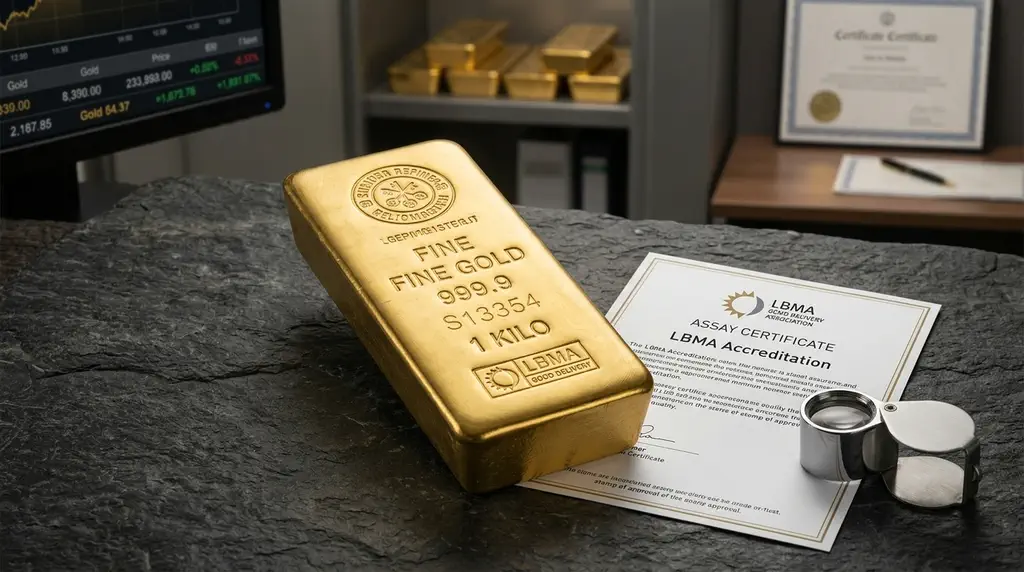
- Refiner. Bars from refineries on the LBMA Good Delivery List command and hold a slightly higher premium, because that recognition is what makes resale frictionless. Our guide to gold bar brands compares them, and what LBMA accreditation means explains what the credential does and does not cover.
- Format. Cast bars are plainer and cheaper to produce than minted bars in sealed cards. Limited editions and designed bars carry a collector premium on top of the metal.
When you compare two quotes, compare the premiums — not the totals. Two dealers quoting different totals at different moments of the same day may be charging identical premiums. Ask any seller for the split. A bullion dealer answers instantly; a jewellery shop selling the occasional bar often cannot.
Two ways to get your bars — delivered or collected
Both work. They suit different buyers, and the practical difference is mostly about who handles the paperwork.
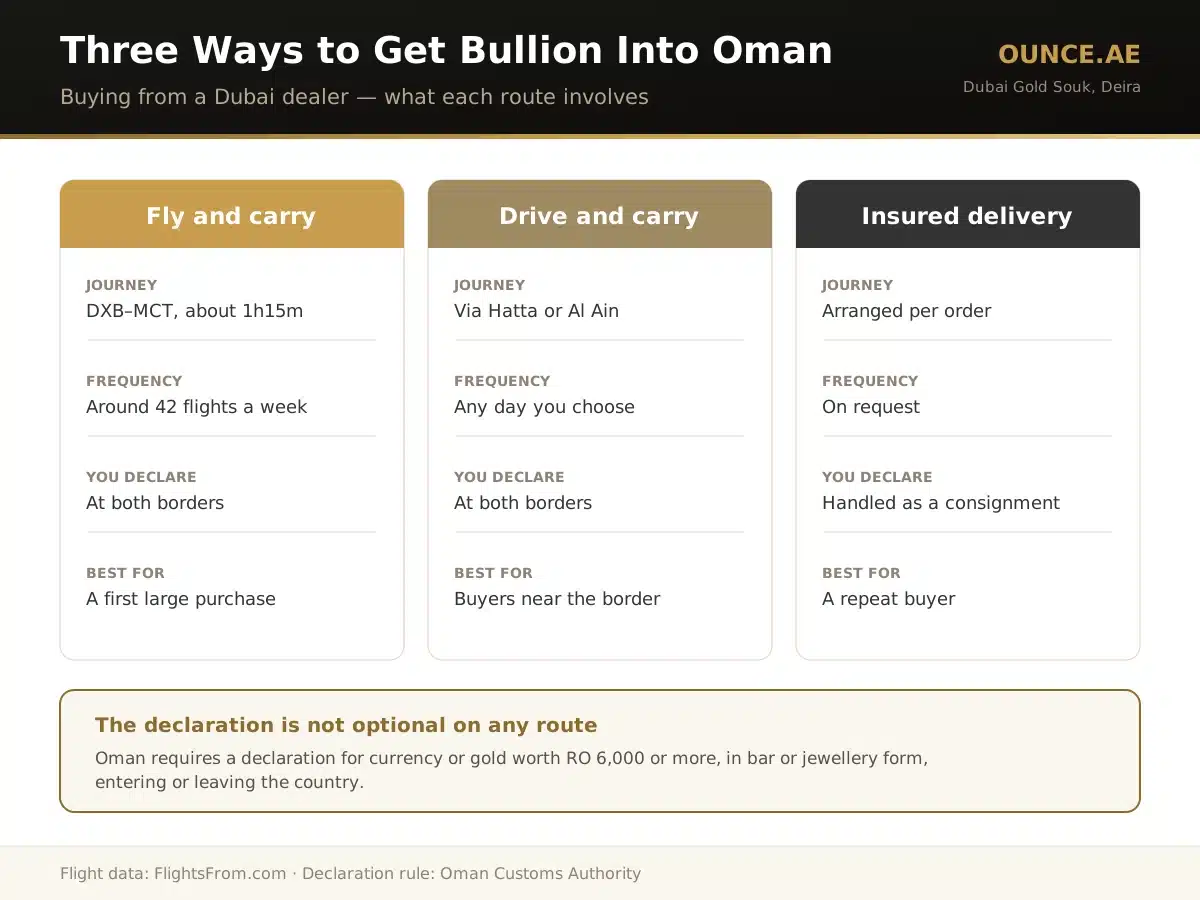
Three ways to get bullion from Dubai into Oman
Delivered to your door in Oman
You order, we arrange insured transport, and the bars arrive sealed at your address. We handle the export side and the clearance paperwork, so the declaration burden is not yours.
Payment is flexible: bank transfer to our UAE account, online payment, or cash on delivery, settled when the sealed bars are handed to you. The Omani rial is pegged to the US dollar and Oman’s banking system handles international transfers normally, so none of these routes is complicated.
One thing worth knowing: gold is not an ordinary parcel. The major express couriers exclude bullion from their networks entirely, and the carriers that do move metal operate as insured secure logistics. That is a different service with different paperwork, which is why delivery is arranged per order rather than quoted from a dropdown.
Before you commit — with us or with anyone — ask these four questions:
- Which carrier is moving it, and is the consignment insured to full value?
- Who is the importer of record, and who files the Omani clearance?
- What happens if customs holds the consignment?
- What is the realistic delivery window, not the best case?
If a seller cannot answer all four, do not send money. We will answer all four in writing before you order.
Collected in person in Dubai
Some buyers want to see the bar before they own it, and Dubai is close enough to make that easy. DXB to MCT is about an hour and a quarter in the air, with nonstop flights daily on Emirates, flydubai and Oman Air. By road, the drive runs through Hatta or Al Ain and is a normal day’s travel.
Message us the refiner and weight before you travel and we will confirm stock and hold it, so you are not browsing a counter under time pressure. Decide the refiner and the weight before you arrive rather than at the counter — it is a much better decision made calmly.
Keep the invoice. You will want it at two borders, and again on the day you sell.
If you collect in person, you carry the bars home yourself, which means the customs declaration is yours to make. That is straightforward, and the next section covers exactly how it works.
Customs and tax, on both sides of the border
This is the section no competing page has, and it is the one that decides whether your purchase is straightforward or stressful.
Leaving the UAE
The Federal Authority for Identity, Citizenship, Customs and Port Security requires travellers entering or leaving the UAE to disclose “possession of cash and the equivalent of negotiable financial instruments, precious metals and stones” when the total exceeds AED 60,000 or its equivalent. Investment bars fall within precious metals.
Read that threshold against the metal rather than against your wallet. At current prices a surprisingly modest bar clears AED 60,000, so most investment-sized purchases require a UAE declaration. This is not a grey area and it is not a tax. Declaring is free and takes minutes; not declaring risks seizure.
Entering Oman
Oman Customs requires a declaration from travellers carrying currency, bearer securities, or “precious metals or gemstones convertible into cash” above RO 6,000, on entry, exit or transit. Investment gold is a precious metal convertible into cash, so plan on declaring.
Declarations are filed through Oman’s electronic cash declaration system before you reach the country, then presented to Customs on arrival.
The penalties for not declaring are real. Under Article 98, an individual faces imprisonment of up to three years and a fine of up to RO 10,000. For a company, fines run from RO 10,000 up to the full value of the undeclared funds. Declaring, again, is free.
→ Oman Customs Authority — traveller services
Duty — the GCC customs union
Oman and the UAE have both been inside the GCC Customs Union since 2003. Goods formally cleared in one member state generally move to another without paying duty a second time. The common external tariff of 5 percent applies to goods entering the bloc from outside it, not to goods moving within it.
VAT — the part that surprises people
Oman introduced VAT at 5 percent under Royal Decree 121/2020. Article 36 of the law sets the standard rate; Article 51 lists what is taxed at the zero rate, and item 3 of that article reads simply: “The supply of investment gold, silver, and platinum.”
The UAE treats investment-grade precious metals of 99 percent purity and above the same way. So a sealed 999.9 bar sits in the zero-rated category at both ends of the journey.
That is genuinely unusual and worth understanding. The thing that makes cross-border gold expensive in most of the world — tax stacking at each border — does not apply here, provided the metal really is investment grade. A 21K jewellery piece is not investment gold and is not treated the same way.
→ Oman VAT Law, Royal Decree 121/2020 — Article 51 (English translation, PDF)
| Stage | What the rule is | Who files it |
|---|---|---|
| VAT in the UAE | Investment-grade precious metals of 99 percent purity and above are zero-rated. There is no export duty on metal you carry out yourself. | Nothing to file |
| Leaving the UAE | Cash, negotiable instruments, precious metals and stones above AED 60,000 must be disclosed to the Federal Authority for Identity, Citizenship, Customs and Port Security. Free, and it takes minutes. | You, if you carry Us, if we ship |
| Customs duty | Oman and the UAE have shared a customs union since 2003. Goods formally cleared in one member state do not pay duty again in another. The 5 percent common external tariff applies to goods entering the bloc, not moving inside it. | No duty due |
| Entering Oman | Oman Customs requires a declaration for currency, bearer securities and “precious metals or gemstones convertible into cash” worth RO 6,000 or more, on entry, exit or transit. Filed electronically before arrival. Non-declaration carries up to three years’ imprisonment and a fine of up to RO 10,000. | You, if you carry Us, if we ship |
| VAT in Oman | Article 51 of the VAT Law, Royal Decree 121/2020, zero-rates “the supply of investment gold, silver, and platinum.” The standard rate of 5 percent does not apply to it. | Nothing to file |
Keep the invoice. It shows weight, purity, refiner and serial number. You may be asked for it at either border, and you will want it on the day you sell.
Which bars travel and resell best
Three things decide how easily a bar converts back into cash in Muscat.
The refiner. Bars from refineries on the LBMA Good Delivery List carry the widest recognition across the Gulf — PAMP Suisse and Valcambi are both on that list. We also stock Emirates Gold, Emirates Minting and BTC, which are well established regionally.
The weight. Small bars carry a higher premium per gram because the manufacturing cost is spread over less metal, but they are far easier to sell in pieces. Larger bars are more efficient to buy and harder to liquidate partially. Our range runs from 1 gram to 1 kilogram, including Tola formats — a denomination the Gulf trade knows well.
The seal. An intact assay card with a matching serial number is the difference between a quick sale and an argument. Never break the seal to “check” the bar.
Buying inside Oman instead
For a small bar you want in your hand today, a local Omani bullion dealer or bank will serve you perfectly well, and you get a counter you can walk back to. That is a real advantage and we are not going to argue against it.
If you go that route, ask the same questions you would ask us: what is the premium over spot as a separate figure, which refiner made the bar, is the assay card sealed, and will you buy it back and at what spread.
Where ordering from Dubai earns its place is on range and price — a specific refiner, a larger weight, a Tola or limited-edition format, a premium quoted as a clear number rather than folded into a making charge, and delivery to your door with the option to pay cash on arrival.
If you are weighing it up, send us the weight and refiner you have in mind and we will give you a straight answer on whether it is worth ordering from us.
Frequently Asked Questions
Can I buy a gold bar in Oman and pay cash on delivery?
Yes. You can settle by bank transfer or online payment in advance, or pay cash when the courier hands you the sealed bars. Check the serial number on the bar against your invoice before you pay.
Is it safe to buy gold bars online for delivery to Oman?
Two things make it safe: insured transport, and a payment method that does not require you to send money to a stranger. Sealed bars travel insured, and cash on delivery means the money moves only when the gold does. Verify the assay card seal and the serial number at the door before accepting the parcel.
How long does delivery to Oman take?
It is arranged per order rather than quoted from a dropdown, because bullion moves through insured secure logistics rather than ordinary courier networks. Ask us for a realistic window when you place the order, and we will put it in writing.
Do I have to declare gold bars at the Omani border?
If you are carrying them yourself and the value is RO 6,000 or more, yes — Oman Customs requires a declaration for precious metals convertible into cash. It is free, filed electronically before arrival, and the penalties for skipping it are severe. If we deliver to you, the clearance paperwork is handled on our side.
Is there VAT on investment gold in Oman?
No. Article 51 of Oman's VAT Law zero-rates the supply of investment gold, silver and platinum. The UAE applies the same treatment to investment-grade metal of 99 percent purity and above, so a 999.9 bar is zero-rated at both ends. Jewellery is a different matter and is not zero-rated.
Is it cheaper to buy gold in Dubai than in Oman?
The metal costs the same everywhere — it is priced internationally. The difference is what sits on top. Jewellery carries a making charge you do not recover on resale; a sealed bar carries a premium quoted as a separate, comparable number. On investment bars specifically, buying from a bullion market rather than a jewellery counter usually means a smaller and more transparent markup.
What weight of gold bar should I buy?
If you may want to sell in portions, several smaller bars beat one large one, despite the higher premium per gram. If you are buying metal to hold, a 100 gram or 1 kilogram bar is the most efficient. Many Gulf buyers split the difference with Tola bars, which are small enough to sell piecemeal and familiar enough to resell easily across the region.