Sell Gold & Silver In Dubai
Request a valuation for your gold and
get expert assistance in Dubai.
Share details
Fill in the simple form
Get contacted
Our team will reach out
Visit for assessment
Bring your items for evaluation
What you are actually being paid for
Every honest offer in this city is built the same way:
weight × purity × the day’s rate − the dealer’s spread
That is the whole formula. There is no fifth term. What varies between one counter and the next is the size of that last item, and whether anyone shows you the first three before applying it.
Notice what is not in the formula. Not what you paid. Not what the receipt said. Not the design, the brand on the box, or the stones. Gold is sold back as metal, and metal is priced by weight and purity.
Check the Dubai rate before you walk in
This is the most useful thing on this page, and most sellers do not know it exists.
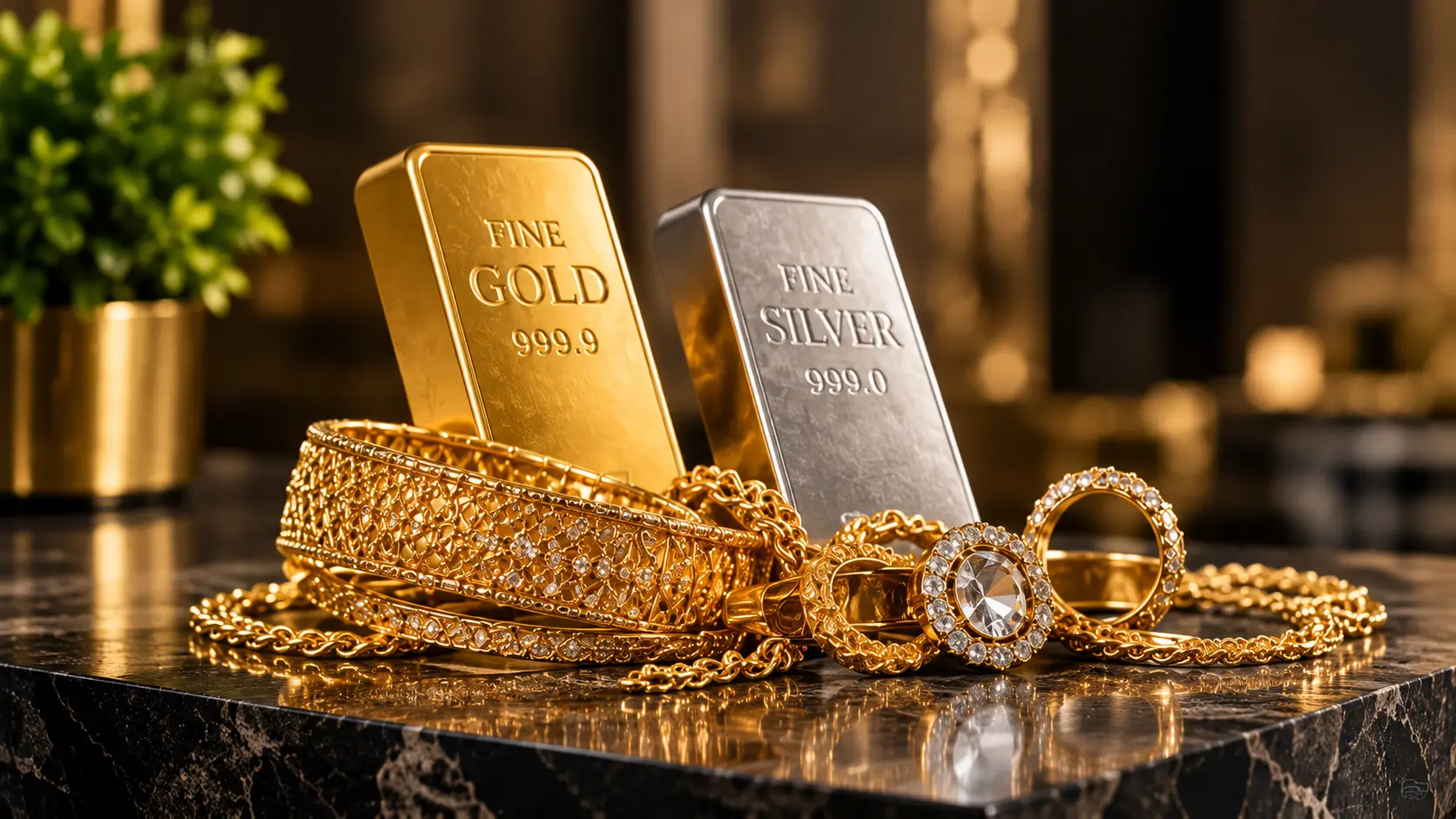
Dubai publishes a daily retail gold rate. The Dubai Gold & Jewellery Group — the Deira-based trade body representing around 600 gold and jewellery businesses — publishes a rate for 24, 22, 21 and 18 carat gold, plus a Ten Tola bar price, updated through the trading day. It is the benchmark the city’s retailers price against.
sell-gold-uae
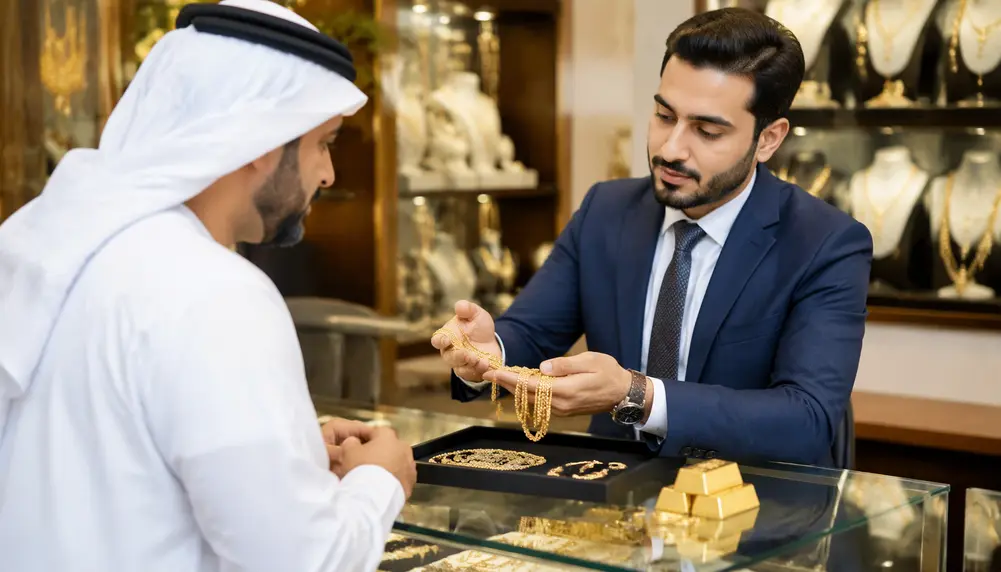
Which means you are not walking in blind. Look up the rate for your karat, multiply by your weight, and you have the metal value of your item before anyone has offered you anything. Any offer can then be judged as a percentage of a number you already know.
→ How the Dubai gold market and its daily rate work
We quote against that rate and we will tell you where our offer sits relative to it. If a buyer cannot or will not express their offer that way, that in itself is information.
How much gold is actually in it
The second term in the formula is the one that surprises people, because jewellery in this region is rarely pure.
| Karat | Fineness | Pure gold in 100 g |
|---|---|---|
| 24K | 999.9 | 99.99 g |
| 22K | 916 | 91.6 g |
| 21K | 875 | 87.5 g |
| 18K | 750 | 75.0 g |
A 100 gram chain in 21K contains 87.5 grams of gold. It is paid as 87.5 grams. The remaining 12.5 grams are the alloy that gave the piece its colour and hardness, and they have no bullion value.
Separate your pieces by karat before you come. Mixed lots have to be tested piece by piece anyway, and sorting them yourself means you can follow the arithmetic as it happens rather than taking a single total on trust.
A bar and a bracelet are not the same sale
Two items can hold identical gold and return very different amounts, because what you are handing over is not just metal — it is how much work the buyer has to do before they can sell gold and silver on.
| What you are selling | How it is treated |
|---|---|
| Sealed bar, recognised refiner, serial intact | Resaleable as it stands. No assay needed. Settles closest to the rate of anything you can bring us. |
| Bar with a broken seal or missing certificate | Still 999.9 gold, but purity now has to be demonstrated rather than read. Testing cost comes off. |
| Small bars and coins | Recognised and quick, though the handling cost is a larger share of a smaller value. |
| Hallmarked jewellery | Paid on metal content at its karat. Design, brand and making charges do not carry over. |
| Jewellery with stones | Gold weighed net of stones. Stones are valued separately, if at all — see the honest note further down. |
| Scrap, broken pieces, single earrings | Entirely sellable. Condition does not matter to metal; only weight and purity do. |
This is why a sealed bar is the most efficient thing to own if you ever intend to sell. It arrives already proven. Our guide to checking a gold bar serial number explains what the verification systems prove.
If you bought bullion from us, bring the invoice. A bar we sold, with its serial and certificate intact, is the simplest transaction in this building.
The making charge was never coming back
The hardest part of selling jewellery is not the offer. It is the gap between the offer and the number on the original receipt.
Gulf jewellery is priced as metal plus a making charge — payment for design, craftsmanship and the shop’s margin. Across the trade it commonly runs from a few percent on a plain band to a quarter or more of the value on intricate or branded work. That charge bought you something real. It simply is not part of the metal, so it does not come back when the metal is sold.
Nobody in Dubai pays a making charge on second-hand jewellery. Not us, not the souk, not the shop that sold it to you. If an offer feels low against what you paid, the making charge is almost always the entire explanation, and the test of a fair buyer is whether they show you the arithmetic rather than simply naming a figure.
There is one way to avoid the gap entirely, and it is worth knowing for next time: buy metal in a form that is priced as metal. That is what investment bars are for.
Watch the test, watch the scale
You are entitled to see every step, and at our counter you will.
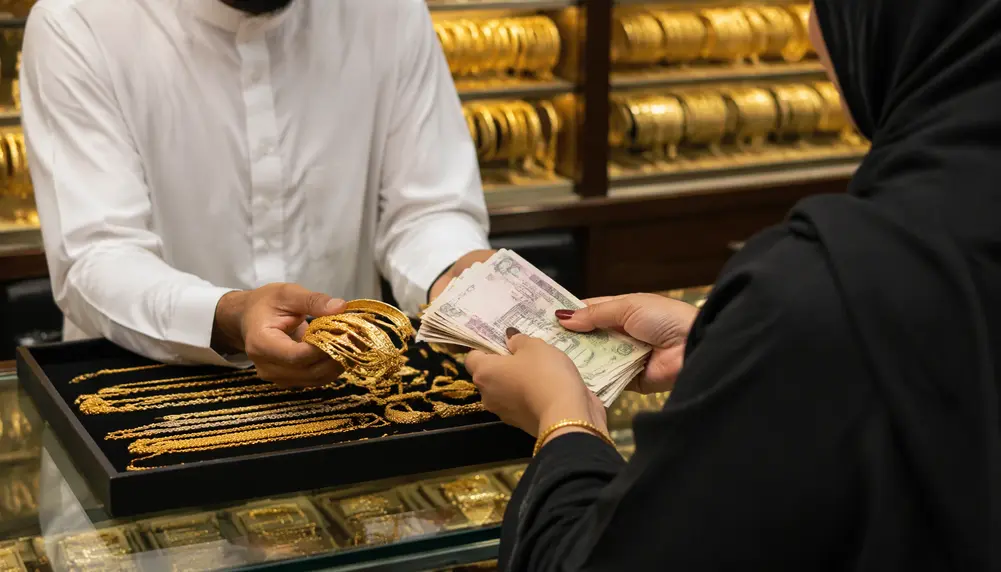
Hallmarks and documents come first, because a sealed assay card or a legible hallmark answers the purity question without any test at all. Where it needs confirming, an XRF analyser reads composition without cutting or melting anything; an acid test does the same job on simpler pieces. Weighing is done on a calibrated scale, with pieces of different karats separated first. Then you get a written breakdown — weight, karat, the rate applied, and every deduction — before you agree to anything.
sell-gold-in-dubai
Three things to insist on anywhere in this city, including here: that you can see the scale display, that mixed karats are weighed separately, and that you receive the numbers in writing before you accept. A buyer who is comfortable with all three is usually comfortable because they have nothing to hide.
Nothing is cut, melted or retained without your agreement. If you decline the offer, your items go back in your hand exactly as they arrived.
What to bring, and what we have to ask
Selling gold in the UAE is a regulated transaction, and the rules apply to the buyer rather than to you. Knowing them in advance is the difference between a half-hour visit and a second trip.
- Photo identification — Emirates ID, or a passport if you are visiting.
- The original invoice, if you still have it. Not required, but it answers questions about purity and provenance instantly, especially on bullion.
- Bank details for larger settlements, which are normally made by transfer rather than in cash.
- An explanation of how you came to own it for higher-value sales. Inherited, bought years ago, bought from us — it is a routine question, not a suspicious one.
The threshold that matters is AED 55,000. At or above it, dealers in precious metals must carry out customer due diligence and file a report through the goAML system with the UAE Financial Intelligence Unit, under the framework set by Federal Decree Law No. 10 of 2025, Cabinet Resolution No. 134 of 2025 and Ministry Circular 08/AML/2021. Linked transactions are added together, so breaking a sale into smaller parts does not avoid anything.
→ UAE Ministry of Economy and Tourism — anti-money laundering
On tax: investment-grade gold of 99 percent purity and above is zero-rated for VAT in the UAE. The treatment of second-hand personal jewellery sold to a registered dealer is different and generally falls under the profit-margin scheme — the position for your circumstances is one for the Federal Tax Authority, and we will tell you plainly what we can and cannot advise on.
When someone else is the better buyer
We would rather say this than have you find out after the fact.
We are a bullion dealer. The closer your item is to pure, recognised, documented metal, the better we are for you — and on a sealed bar from a listed refiner, very few buyers in this city will beat us. That is simply what we are set up to do.
Where we are not necessarily your best outcome:
- Significant gemstones. We price gold. A piece whose value sits largely in its diamonds should be seen by someone who prices diamonds, or sold privately.
- Antique, signed or collectible pieces. If a bracelet is worth more as that bracelet than as its gold, melting value is the wrong measure of it. A specialist or an auction house may do far better.
- Branded luxury jewellery in original condition. The brand can carry resale value in a market that recognises it. The metal market does not.
Turn Your Gold Into Value
Bring it in anyway if you are unsure. We will tell you which category it falls into, and if the answer is “not us”, we will say so and tell you where to look instead.
Getting a figure today
Two ways, and neither commits you to anything.
Send the details. Use the valuation form on this page — item type, karat if you know it, approximate weight — and we will come back with an indicative range. It is indicative because a figure only becomes firm once the item has been weighed and tested, and any buyer who gives you a firm number sight-unseen is guessing.
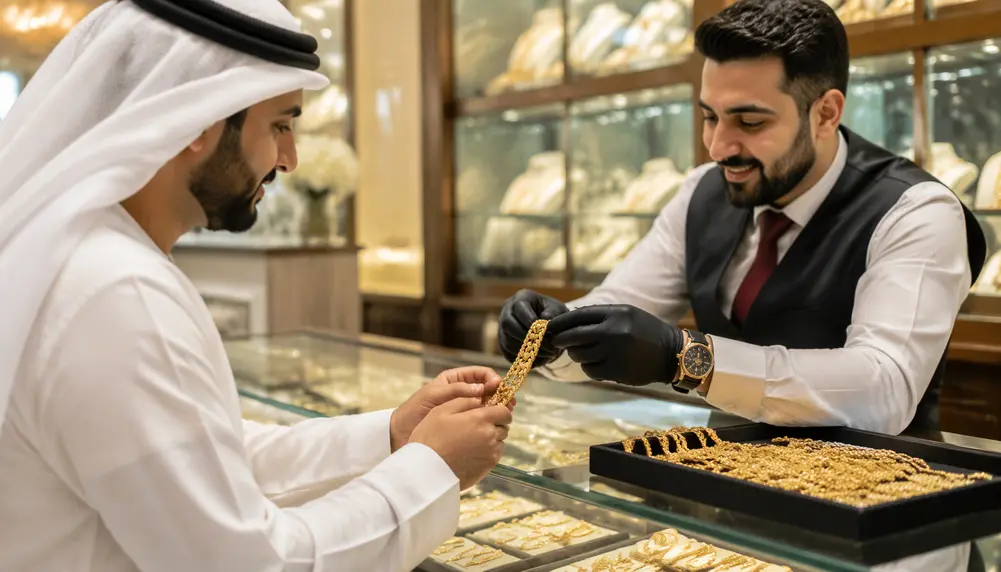
Or bring it to the counter. We trade from the Dubai Gold Souk in Deira. Weighing and testing take minutes, the breakdown is written down, and you leave with either payment or your items — your choice, made after you have seen the numbers.
If you have a larger holding, or you are selling on behalf of an estate, message us first and we will tell you exactly what to bring so it is settled in one visit.