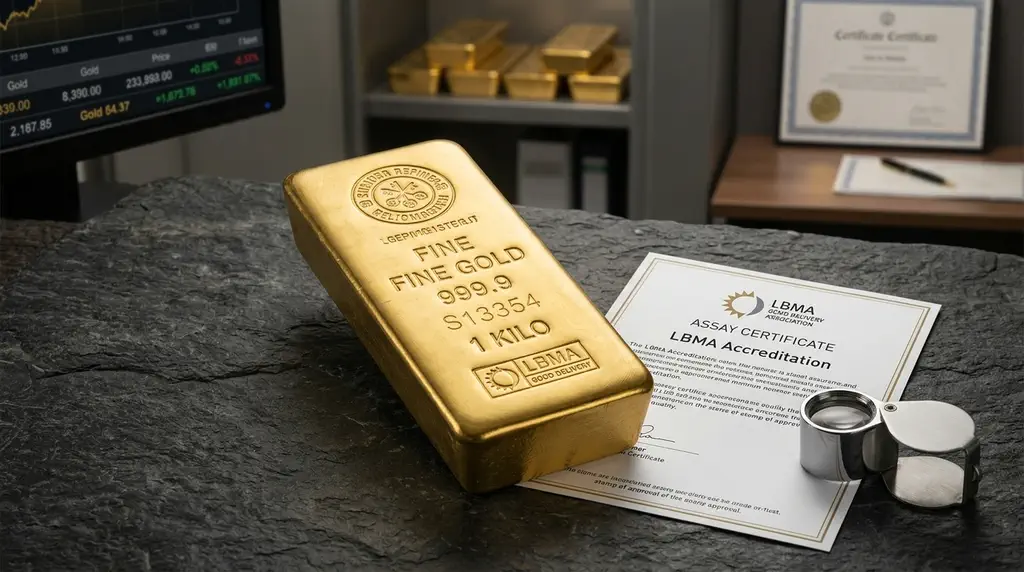
Walk through any gold market, open any bullion website, and you will see the same three letters used as a seal of approval. LBMA. It appears on dealer homepages, in product descriptions, in advertising, and in a great deal of content written by people who have never read the rules.
Most of what is said about LBMA accreditation is wrong in a specific and consequential way, and the error costs gold and silver investors money at the point of resale.
This page explains what the London Bullion Market Association actually accredits, what LBMA accreditation means, what it very deliberately does not cover, and how to use any of it when you are standing in front of a bar deciding whether to buy.
The phrase almost every dealer gets wrong
There is no such thing as LBMA certification.
The association runs two separate things that people routinely collapse into one:
Membership. Banks, brokers, refiners and traders can join the LBMA in various categories — Full Member, Associate, Affiliate, Subscriber. Membership signals a commitment to the association’s standards and gives access to its market framework. It is not a quality mark on any physical product.
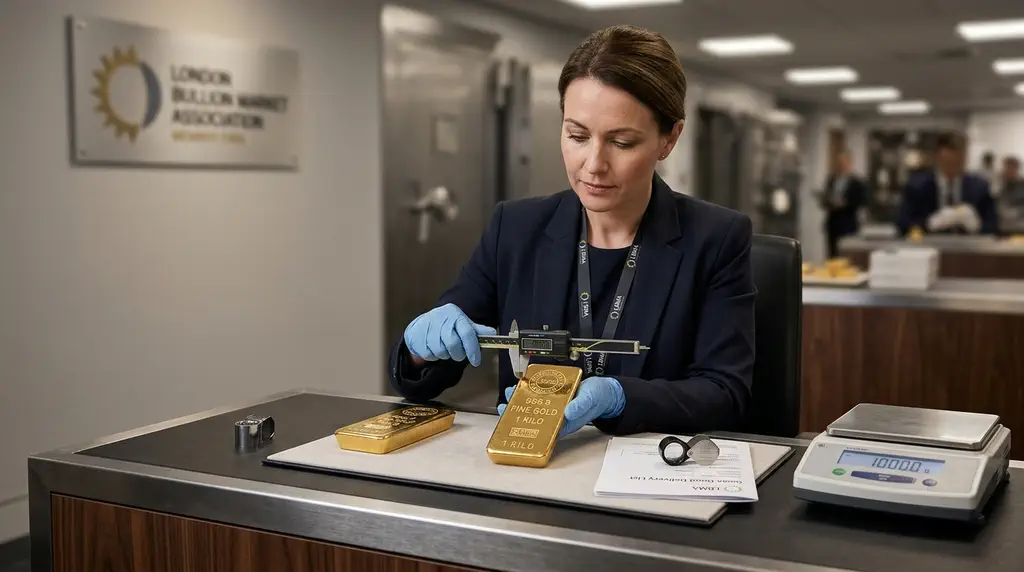
LBMA Good Delivery List
Good Delivery accreditation. This applies to refiners only, and to a specific refinery at a specific location. It means that refinery’s large bars are acceptable for settlement in the London wholesale market.
Neither is called “certification”, and neither is available to a retail dealer. A shop that sells gold cannot be LBMA accredited, because accreditation is a thing that happens to refineries that pour 400-ounce bars.
| Who it applies to | What it means | |
|---|---|---|
| LBMA Membership | Banks, brokers, refiners, traders | Commitment to association standards |
| Good Delivery accreditation | Refineries, per location | Large bars accepted in the London market |
| “LBMA certified” | Nobody | Does not exist |
If a seller describes themselves as LBMA certified, they are naming something that is not real. That does not automatically make them dishonest — the phrase has spread far enough that many people repeat it in good faith — but it does tell you something about how carefully they use language, and in this business language is usually a proxy for everything else.
What it actually takes to get on the list
The requirements are public , and they are severe. A refinery applying for Good Delivery accreditation must demonstrate all of the following.
| Requirement | Minimum |
|---|---|
| Time the company has existed | 5 years |
| Time refining that specific metal | 3 years |
| Annual refined gold production | 10 tonnes |
| Annual refined silver production | 50 tonnes |
| Tangible net worth | £15 million |
| Responsible sourcing audit | Passed before applying |
On top of that, the applicant’s ownership, financial standing and reputation must satisfy the due diligence tests used in the London market. Then come the assay tests and the sample bars.
From a complete application to accreditation takes a minimum of about four months, and in practice around six.
Three details matter more than most investors realise.
An entry on the list is a refinery, not a brand. A group operating refineries in several countries appears on the list several times, once per site. A bar from an accredited group’s non-accredited plant is not covered.
The checks do not stop. The LBMA conducts an annual review of each refiner’s tangible net worth and refined production, runs a Proactive Monitoring programme, and operates a Proficiency Testing Scheme for assay laboratories.
The list is small. There are 66 refiners on the current gold list and 84 on the silver list. Worldwide. Against the number of companies producing gold bars globally, that is a narrow gate.
If you want to see how individual refineries differ in practice, our guide to gold bar brands compares the ones you are most likely to encounter, including PAMP.
What Good Delivery does not cover
Here is the part that almost never appears in retail content, stated by the LBMA itself in its own published FAQ.
Good Delivery applies to gold bars of approximately 400 troy ounces and silver bars of approximately 1,000 troy ounces. The association’s answer to the question of whether smaller bars from accredited refiners also count is direct: kilobars, 100-ounce bars and smaller bars are not acceptable in the London wholesale market.
So if you own a 1 gram bar, a 100 gram bar, or even a 1 kilogram bar, you do not own a Good Delivery bar. You own a bar made by an accredited refiner, which is a genuinely valuable thing — but it is a different thing, and the distinction is not pedantry. It is the difference between a product specification and a producer’s credentials.
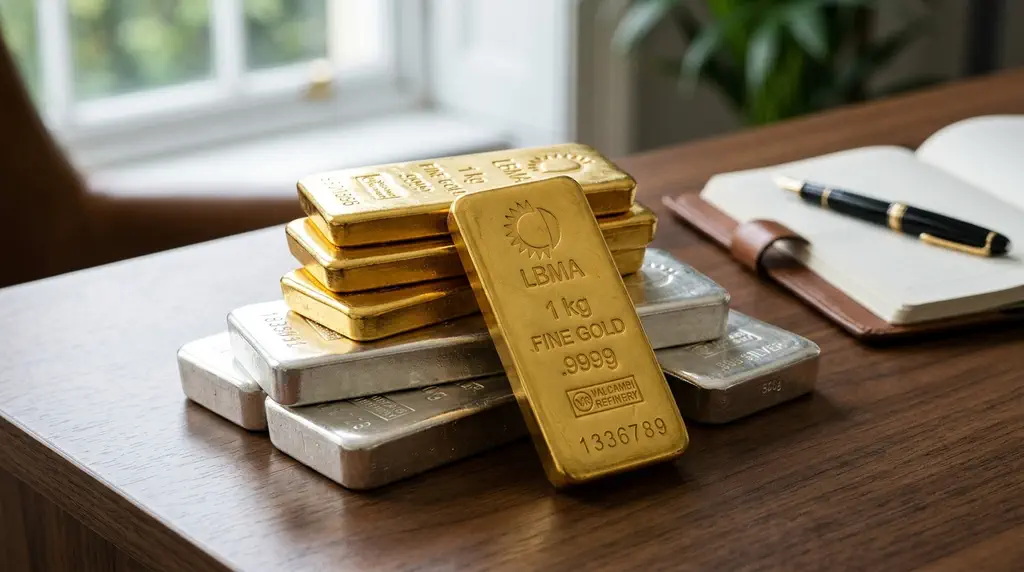
what is LBMA
There is a second correction worth making while we are here. Good Delivery does not mean 999.9 fine. The minimum fineness for a Good Delivery gold bar is 995. Plenty of content asserts that LBMA accreditation guarantees four-nines purity; it does not, and the bars traded between London institutions are frequently below it.
So why should a retail buyer care at all?
Because the refinery’s credentials follow the metal down to the smallest bar it makes.
A refinery that must hold £15 million in tangible net worth, pour ten tonnes a year, and pass an annual responsible sourcing audit is not going to run a different standard on its 10 gram line. The accreditation is a statement about the institution behind the bar, and that institution’s reputation is what a buyer in another country is pricing when they decide what to pay you.
In practice, small bars from accredited refiners resell more easily and at tighter discounts than bars from unaccredited producers. That gap is the entire commercial value of the thing.
LBMA Good Delivery is not the only Good Delivery
This matters more in the UAE than almost anywhere else, and international guides never mention it.
The UAE operates its own standard: UAE Good Delivery, or UAEGD. It succeeded the Dubai Good Delivery standard in November 2021 and is governed by the Emirates Bullion Market Committee. It was designed around kilobars with a minimum fineness of 995 and functions as the physical delivery standard for the Dubai Gold and Commodities Exchange.
A refinery can hold UAEGD without holding LBMA Good Delivery. It can hold LBMA without UAEGD. Some hold both. The standards overlap in intent but they are separate schemes with separate lists and separate committees.
Which means that when a dealer anywhere in the Gulf tells you a bar is “Good Delivery”, the only sensible response is to ask which one. It is a fair question, it takes four seconds, and the answer tells you whether the person opposite you knows their own market.
Our guide to where to buy gold bars in Dubai covers the channels where you are most likely to need to ask it.
What happens if a refiner loses accreditation
Accreditation can be withdrawn, and the grounds are published. A refinery can be moved to the Former List if its tangible net worth falls consistently below £15 million, if its production falls consistently below the minimum, if ownership changes and the new owners cannot establish their bona fides, if it ceases production, if it fails to maintain the technical standards — or, notably, if it does not respond adequately to justifiable customer complaints.
That last one is unusual and worth sitting with. Customer treatment is a listing condition.
Which raises the question an actual owner asks: if the refinery that made my bar gets delisted, is my bar worthless?
No. The LBMA’s position is explicit. Bars produced by a refiner while it was on the list continue to be acceptable as Good Delivery after that refiner moves to the Former List. Delisting is forward-looking, not retroactive.
There is also a complaints mechanism almost no investment guide mentions. If the LBMA receives complaints about the quality of a refiner’s bars, it will investigate, and where the complaint appears justified it will write to the refiner asking it to stand behind its bars by making appropriate restitution to the customer. That is a real, if indirect, line of recourse sitting behind every accredited bar.
A regional example
In July 2023, Emirates Gold had its UAE Good Delivery accreditation suspended, and the LBMA suspended its membership shortly afterwards following a due diligence review. The refinery later returned to the UAE list after a change of ownership.
We mention it because we stock Emirates Gold bars and because the episode illustrates the mechanism precisely: the standards have teeth, suspension is real, and bars already in circulation were not invalidated by it.
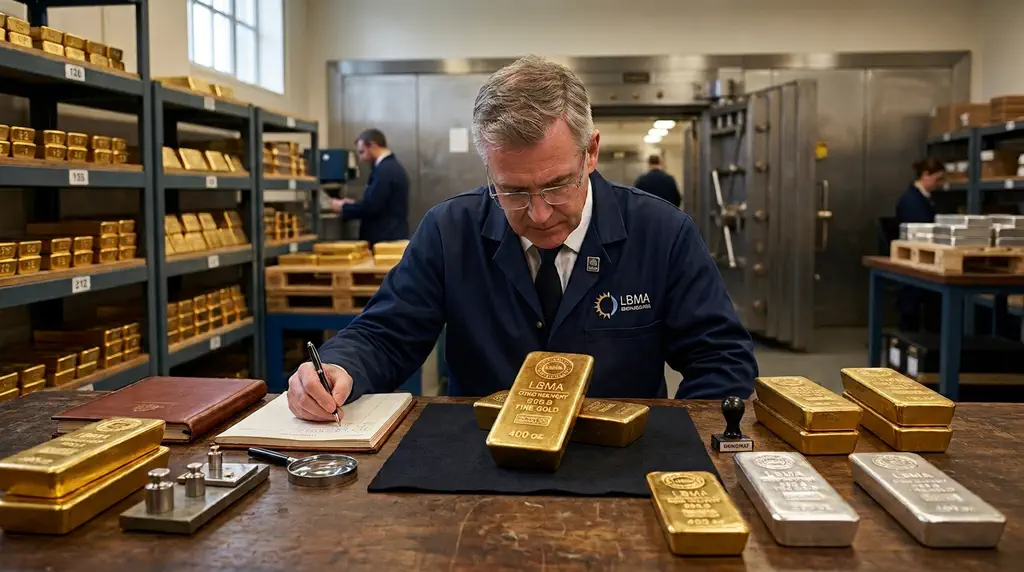
LBMA good delivery requirements
Responsible sourcing, and why it reaches your bar
Every refiner on the Good Delivery List must operate under the LBMA’s Responsible Sourcing Programme, with independent annual auditing and public reporting. For gold this runs on the Responsible Gold Guidance, currently at version 9, with version 10 now in its second public consultation.
Country of origin data is published. Audit outcomes are published. A refinery that cannot demonstrate a clean supply chain does not stay on the list.
For a private buyer this is not an abstraction. Provenance affects what happens when you sell, particularly across borders, and particularly in a sanctions environment that has tightened considerably for gold in recent years. A bar whose refinery is inside an audited chain is simply an easier object to move and resell than one whose origin nobody can speak to.
Two rule changes most buyers missed
The standard is not static. Two recent changes are worth knowing about, if only because they demonstrate that the rulebook is actively maintained rather than ceremonial.
From 1 January 2025, Good Delivery silver bars must be produced within a weight range of 1,000 troy ounces plus or minus 10 percent. This replaced the 750 to 1,100 ounce range that had been in force since 1999, following market consultation.
From 1 January 2026, a rule change prohibited non-Roman lettering in serial numbers, date markings and fineness markings for new Good Delivery refiners. Existing refiners will be asked to make the change as part of future bar modifications.
And one ongoing piece of work that bears directly on counterfeiting. The LBMA has an active research programme into porosity in cast bars — the small air pockets that form during continuous induction furnace casting. Porosity is not itself a defect serious enough to fail a bar, but it interferes with ultrasonic testing, and heavy porosity can scatter the signal in ways that look like something worse. Part of that research is explicitly aimed at distinguishing porosity from inclusions and solid inserts such as tungsten rods.
In other words, the body that sets the standard is working on the exact problem that keeps bullion buyers awake. That is a reasonable thing to know about the institution standing behind your bar.
How to use any of this when you buy
Accreditation is a signal about the refinery. It is not a guarantee about the specific piece of metal in your hand, and it does not replace the checks you should be making anyway.
A short, practical sequence:
- Look up the refinery, not the dealer. The current Good Delivery Lists are public. Search the refinery name.
- Check the location. The list records refineries at specific sites. A group name alone is not enough.
- Ask which standard. LBMA Good Delivery, UAE Good Delivery, or both.
- Do not expect a small bar to be a Good Delivery bar. It will not be, and a seller who claims otherwise is either confused or counting on you being confused.
- Read the stamp rather than the listing. Fineness varies by refiner and by format, and the bar is the authority.
- Verify the bar itself. The seal, the serial number, the assay card. Our guide to checking a gold bar serial number explains what each refiner’s verification actually proves, which is less than most people assume.
For gold and silver investors, what LBMA accreditation means is worth paying attention to for one unglamorous reason: bars from accredited refiners resell more easily, in more markets, to more buyers. We stock them for that reason, and we would rather you understood the mechanism than took the three letters on faith. If you want to talk through a specific refiner or a specific bar before buying, message us.
Frequently Asked Questions
What does LBMA accreditation actually mean?
It means a specific refinery at a specific location has been accepted onto the LBMA Good Delivery List, after proving at least five years in business, three years refining that metal, 10 tonnes of annual gold production or 50 tonnes of silver, tangible net worth of at least £15 million, and a passed responsible sourcing audit.
Is a 1 gram gold bar LBMA Good Delivery?
No. Good Delivery covers gold bars of approximately 400 troy ounces and silver bars of approximately 1,000 troy ounces. Smaller bars, including kilobars, are not accepted in the London wholesale market. A small bar from an accredited refiner is a bar from an accredited refiner — a different and more modest claim.
What is the difference between LBMA membership and Good Delivery accreditation?
Membership is open to banks, brokers, refiners and traders, and signals commitment to the association's standards. Good Delivery accreditation applies only to refineries and only to their large wholesale bars. A company can hold one without the other.
How many refiners are on the LBMA Good Delivery List?
66 for gold and 84 for silver at the time of writing, worldwide. The lists change, so check the current figures directly.
Does the LBMA certify gold dealers?
No. There is no LBMA certification scheme, and no retail dealer can be LBMA accredited. Accreditation is for refineries.
Is UAE Good Delivery the same as LBMA Good Delivery?
No. UAE Good Delivery is a separate national standard, successor to Dubai Good Delivery, governed by the Emirates Bullion Market Committee and used as the delivery standard at the DGCX. A refinery may hold either, both, or neither.
What happens if my refiner is removed from the list?
Bars produced while the refiner was accredited remain acceptable as Good Delivery. Delisting is not retroactive.
Do LBMA Good Delivery bars have to be 999.9 fine?
No. The minimum fineness is lower than most buyers assume, and four-nines purity is a product choice rather than a Good Delivery requirement.