
To check gold bar serial number, start with the simplest test: every investment-grade bar carries a serial engraved on the bar and repeated on its assay card, and the first check is that the two match. What you can do beyond that depends entirely on the refiner — and contrary to what most search results suggest, Valcambi does not operate a public online serial-number lookup.
If you have searched for a Valcambi serial number checker and not found one, you are not missing something. It does not exist publicly, and several pages ranking for that search describe a tool that is not on Valcambi’s website.
Here is what is genuinely possible for each of the three brands most commonly held in the UAE, what each check actually proves, and what to do when a check fails. If you are still deciding what to buy rather than verifying something you own, how the major refineries compare is the better starting point.
Where the Serial Number Is on Your Bar
On the bar face and on the assay card
On a minted bar the serial is laser-etched on the front, usually beneath the weight and fineness — for example under “999.9 FINE GOLD”. The same number is printed on the assay card sealed around it.
You should therefore be able to read the number twice: once on the metal, once on the card. If your bar came with an invoice from a dealer, that is a third place it should appear.
Two exceptions are normal and not cause for alarm. Very small bars — typically 1g and 2.5g — are sometimes issued without individual serials. And some older bars predate the practice of serialising every piece.
If the two numbers do not match
Treat a mismatch as a stop signal. A genuine bar and its certificate are issued together as a unit.
The usual cause is not a counterfeit bar but a repackaged one: a real bar removed from its original card and placed in another. The metal may be genuine while the certificate no longer certifies it. Either way its value is compromised, because the next buyer will make exactly this check.
Do not break the seal on a matching bar. Once the tamper-evident packaging is opened, the certification chain is broken and most dealers will re-test the bar before buying it back.
There is one situation where people break the seal on purpose, and it is almost always a gift. Before you unwrap a bar to make it look better in a box, read what that costs the person receiving it in giving gold as a gift.
What You Can Actually Check, by Refiner
Verification options differ far more between brands than most guides admit.
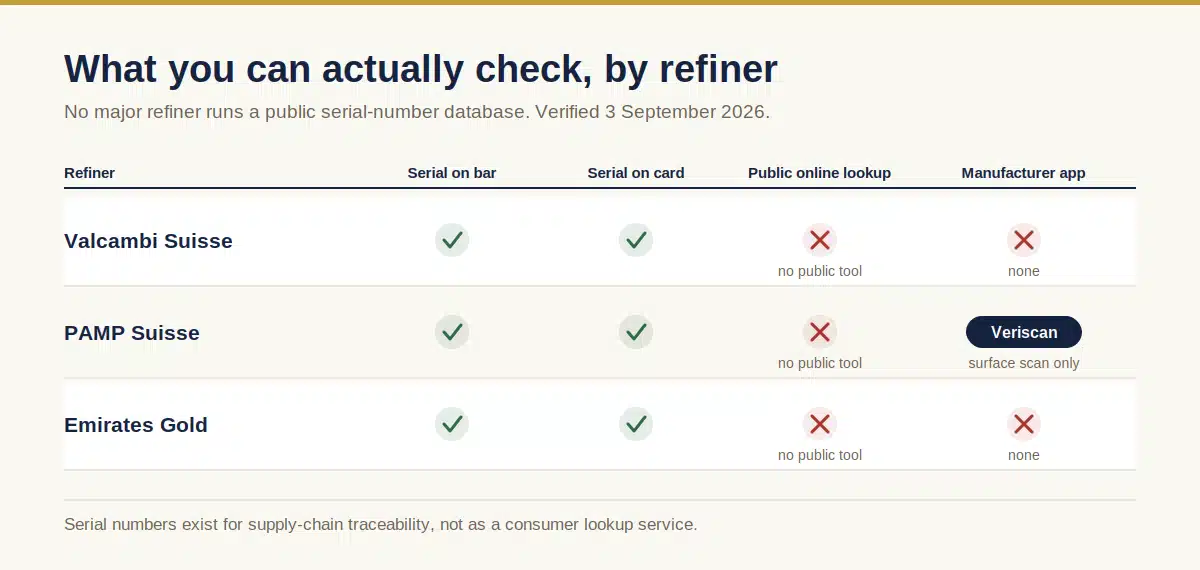
| Refiner | Serial on bar | Serial on card | Public online lookup | Manufacturer app |
|---|---|---|---|---|
| Valcambi Suisse | Yes | Yes | No public tool | No |
| PAMP Suisse | Yes | Yes | No | Veriscan (surface scan, not a serial lookup) |
| Emirates Gold DMCC | Yes | Yes | No public tool | No |
The key point: no major refiner offers a public “type in your serial number” database. Serial numbers exist for traceability within the supply chain, not as a consumer lookup service — LBMA’s Good Delivery standard requires them to be unique, non-reusable and matched against refiners’ inventory records. Anyone telling you otherwise has not checked.
One clarification worth making, because it is widely got wrong: Good Delivery itself applies to large wholesale bars of roughly 400 troy ounces. A 50g retail bar is not a “Good Delivery bar”. The refiner is accredited; the small bar sits outside the standard’s scope.
That does not leave you without options. It changes what the options are.
Checking a Valcambi Suisse Bar
Is there a Valcambi serial number check online?
No. As of 5 September 2026, Valcambi’s own website has no serial-number lookup, certificate verification tool or authentication page. The site’s sections are About us, Products, Services, Responsibility, Careers, News, Downloads, Contact and Resellers. None contains a verification function.
Some articles ranking for this search instruct readers to find an “Assay Certificate” section under Valcambi’s Products or Customer Support menus. There is no such section, and Valcambi’s menu has no Customer Support heading.
What actually works for a Valcambi bar
- Read the serial on the bar face — engraved beneath the weight and fineness marks.
- Read the serial on the assay card. Confirm the two are identical, character for character.
- Check the packaging is intact. Valcambi minted bars ship sealed; a card that has been opened and re-sealed is a problem regardless of the number.
- Verify the physical marks. Per Valcambi’s minted bar specification, a standard minted bar carries the logo, weight, metal name, fineness, the essayeur fondeur assay mark and the bar number, with “Valcambi Suisse” on the reverse. Older standard bars show only the Valcambi name on both sides, which is why some genuine older bars carry no serial on the face.
- Check weight and dimensions against Valcambi’s published specification for that bar. A counterfeit that matches the design rarely matches the exact weight and dimensions.
- Contact Valcambi directly if genuine doubt remains. There is no self-service tool, but the refinery can be approached about a specific serial. Expect this to take time and to be intended for exceptional cases, not routine reassurance.
- Have it tested by a dealer. For most owners this is faster and more conclusive than any of the above.
If you are buying rather than checking, purchasing sealed Valcambi Suisse bars in stock from an established dealer removes the question at source.
Why a Valcambi certificate has no signature
This one causes unnecessary alarm, so it is worth stating clearly.
Valcambi’s certificates carry no assayer’s signature, and this is deliberate. Valcambi holds the assayer’s and melter’s licence as a company rather than through a named individual, so a personal signature is not legally required for a certificate it issues. The certificate still states the fineness, the weight in grams and Valcambi’s certified assayer hallmark. (Source: Valcambi minted bars product documentation, valcambi.com.)
An unsigned Valcambi certificate is therefore normal. Judge the card by the hallmark, the serial match and the seal — not by a missing signature.
Checking a PAMP Bar with Veriscan
What Veriscan actually checks
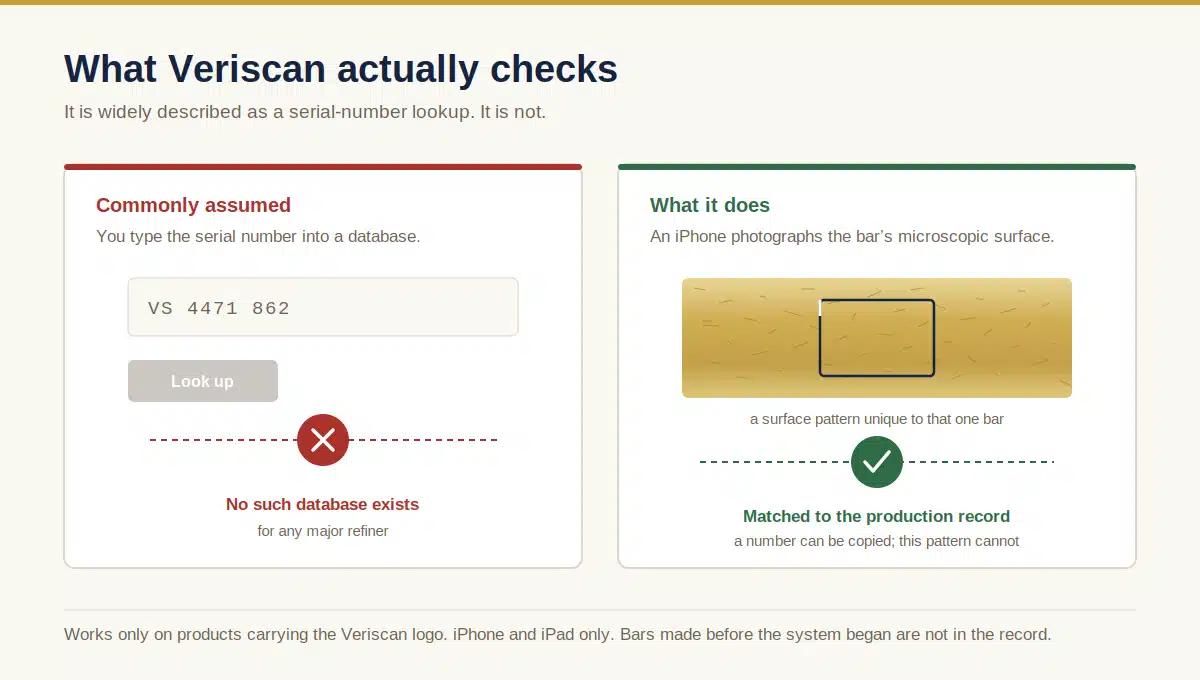
Veriscan is frequently described as a serial-number checker. It is not. PAMP’s own documentation describes something different.
Veriscan photographs the microscopic surface topography of the bar — the pattern of tiny irregularities left during manufacture, unique to each individual piece in the way a fingerprint is. That pattern is recorded at the point of production and stored. When you scan the bar, the app compares what it sees against the stored record.
This makes it stronger than a serial check in one important way. A counterfeiter can copy a number; the surface texture of a specific bar cannot practically be reproduced.
How to run a Veriscan check
- Confirm the bar or its certificate carries the VERISCAN logo. Without it, the product is not in the system and the check will not work.
- Download the VERISCAN app from the Apple App Store. It is free, scans are unlimited, and the interface is available in Arabic as well as English.
- Follow the app’s positioning guidance to scan the bar’s surface. On some larger denominations in CertiPAMP packaging, enhanced authentication allows scanning without unsealing.
- Read the result. The app returns a pass or a fail.
The three limitations nobody mentions
| Limitation | What it means |
|---|---|
| iOS only | The app is available for iPhone and iPad. Android users need to borrow a device or use a dealer. |
| VERISCAN logo required | Only products bearing the logo are registered. No logo, no check. |
| Older bars are absent | PAMP bars produced before Veriscan was introduced were never recorded, so a genuine older bar can return no match. |
The third point matters most. A failed or absent Veriscan result on an older PAMP bar is not proof of a counterfeit. It may simply mean the bar predates the database. Fall back to the physical checks below rather than assuming the worst.
For bars bought new, buying verified PAMP gold bars from a dealer that supplies them sealed means the Veriscan record and the packaging are intact from the start.
Checking an Emirates Gold Bar
Emirates Gold DMCC is UAE-refined and widely held locally, so its bars turn up constantly in the Dubai secondary market.
Like Valcambi, Emirates Gold operates no public online serial lookup. Verification is physical and dealer-based:
- Match the serial on the bar to the serial on the assay card.
- Confirm the Emirates Gold hallmark, the stated weight and the fineness mark.
- Check the packaging seal is unbroken.
- Have the bar XRF-tested. Emirates Gold bars are common enough in the UAE that any established dealer will have handled many.
Being locally refined is an advantage here: a bar that is familiar to every dealer in the market is a bar that is easy to check and easy to sell.
What a Genuine Assay Card Looks Like
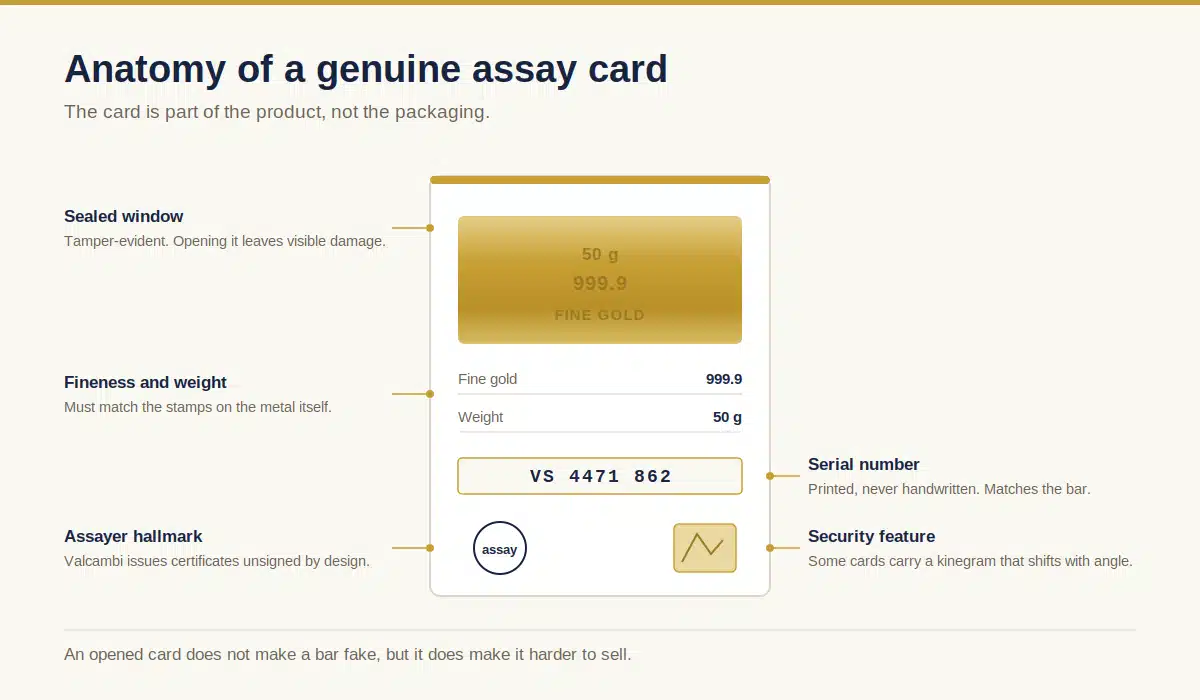
The card is part of the product, not the wrapping.
- Tamper-evident seal. Designed so that opening it leaves visible evidence. Look for cut edges, re-glued seams or a card that feels re-fitted.
- A serial matching the bar, printed rather than written.
- Fineness and weight stated on the card, matching the stamps on the metal.
- The refiner’s assay mark or hallmark.
- Security features where the refiner uses them — some cards carry a kinegram or holographic element that shifts with viewing angle, and PAMP’s CertiPAMP packaging carries the VERISCAN logo and QR code where applicable.
A card that has been opened does not make the bar fake. It does make it harder to sell, because the next buyer inherits the same uncertainty you are trying to resolve. If you have a choice, buy sealed. If you are comparing refiners on packaging and premium, PAMP vs Valcambi compared covers that ground.
Six Signs of a Counterfeit Bar
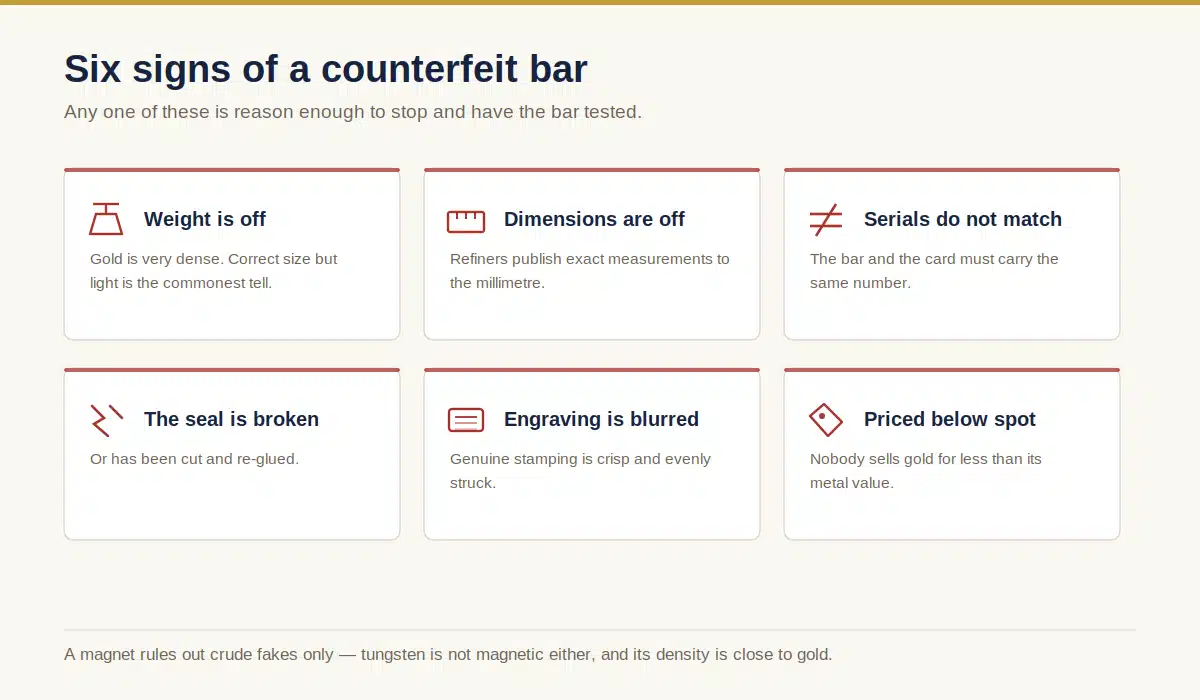
- Weight is off. Gold is extremely dense. A bar that is correct in dimensions but light is the commonest tell.
- Dimensions are off. Refiners publish exact measurements. Counterfeits reproduce the look, rarely the millimetres.
- Serials do not match between bar and card.
- The seal has been broken or re-made.
- Blurred or uneven engraving. Genuine stamping is crisp and consistent.
- The price is below the metal value. Nobody sells gold below spot. If a deal looks impossible, it is.
If you are unsure whether a refiner is reputable at all, check it against LBMA’s current list of accredited gold refiners. A name that appears nowhere on it is not automatically fake, but it is a reason to look harder.
A magnet test is worth thirty seconds — gold is not magnetic, so attraction rules a bar out immediately. But passing a magnet test proves very little, because tungsten, the metal used in serious counterfeits, is not magnetic either and has a density close to gold. Use it to eliminate crude fakes, not to confirm a bar.
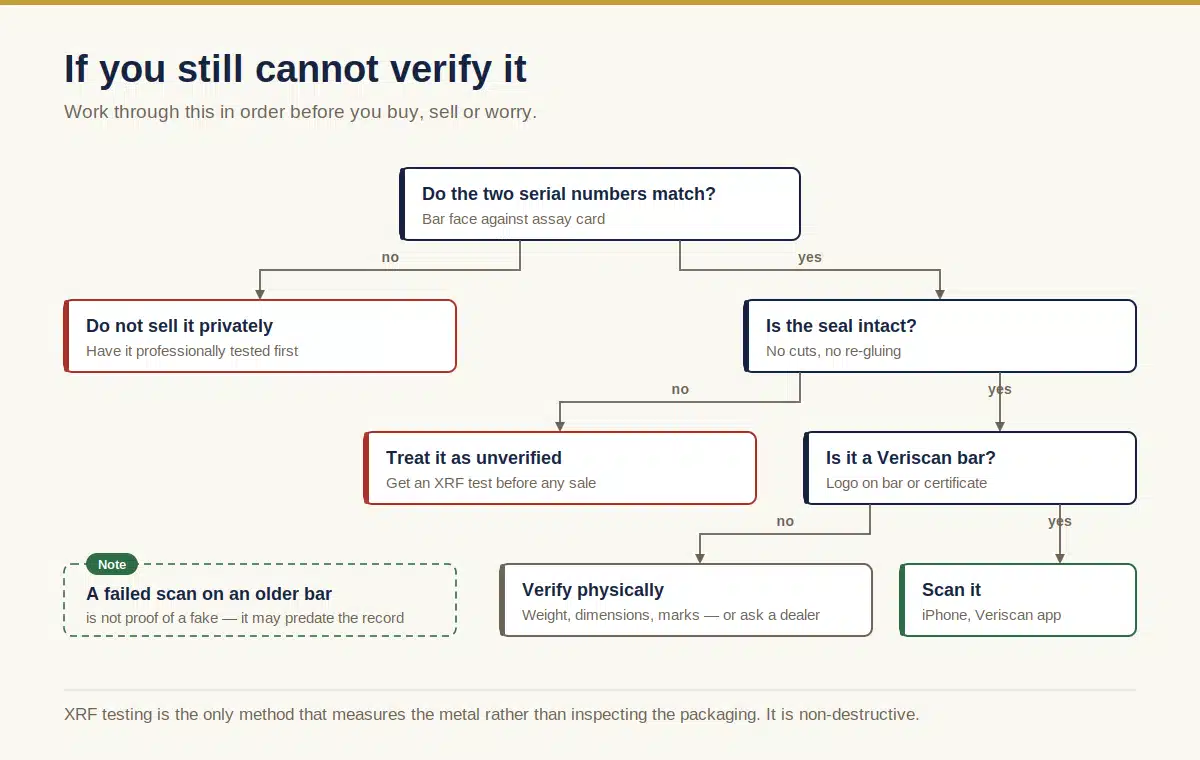
If You Still Can’t Verify It
Work through this in order:
Serials match, seal intact, marks correct → Your bar is consistent with a genuine product. No further action needed.
Veriscan fails on an older PAMP bar → Likely predates the database. Verify physically instead.
Serials don’t match, or the seal is broken → Do not sell it privately. Have it professionally tested before doing anything else.
Bought from an unknown online seller and something feels wrong → Get it tested immediately. Dispute windows on payment platforms are short.
You want certainty rather than probability → XRF testing at a dealer or an accredited laboratory is the only method that measures the metal rather than inspecting the packaging. It is non-destructive.
Frequently Asked Questions
How do I know if my gold bar is real?
Check three things in order: the serial on the bar matches the serial on the assay card, the packaging seal is unbroken, and the weight and dimensions match the refiner's published specification. For certainty, have it XRF-tested by a dealer.
Can you check a Valcambi serial number online?
No. Valcambi does not operate a public serial-number lookup or certificate verification tool. Verify by matching the serial on the bar to the assay card, checking the hallmark and seal, and having the bar tested by a dealer.
What is PAMP Veriscan?
Veriscan is PAMP's authentication system. It scans the bar's microscopic surface texture with an iPhone app and matches it against a record made during production. It checks the surface, not the serial number, and only works on products carrying the VERISCAN logo.
Do all gold bars have serial numbers?
Most investment bars from major refiners do, engraved on the bar and repeated on the assay card. Very small bars — often 1g and 2.5g — are sometimes issued without individual serials, and some older bars predate the practice.
What does a fake assay card look like?
Common signs are a serial that does not match the bar, a seal that has been cut or re-glued, handwritten rather than printed details, blurred printing, and missing security features. Note that Valcambi certificates carry no assayer's signature by design — that alone is not a red flag.