is investment gold VAT-free in UAE? This is the question that gets answered badly more often than almost any other in the Dubai gold trade, usually in one of two directions. Either everything gold is described as tax-free, which is not true, or the 5% rate is quoted flatly across the board, which is also not true. Both answers cost buyers money — the first at the till, the second by scaring people off a product that genuinely carries no VAT.
Below is the actual legal position, with the article numbers so you can check it yourself, and a product-by-product table you can hold your own invoice against.
VAT on gold bars in UAE
Zero-rated is not exempt, and the difference belongs on your invoice
These two terms get used interchangeably in almost every gold article online. They are not the same thing, and for a gold buyer the distinction is not academic.
A zero-rated supply is a taxable supply on which the rate happens to be 0%. The UAE government’s own VAT guidance puts it plainly: zero-rated supplies are “still VAT taxable but the rate of VAT is 0%”, and “certain investment precious metals” are named in that list. An exempt supply sits outside the tax altogether.
| Zero-rated (0%) | Exempt | |
|---|---|---|
| Is it a taxable supply? | Yes, at a rate of 0% | No |
| VAT charged to you | AED 0 | AED 0 |
| Seller recovers input VAT on related costs | Yes, subject to the normal rules | No |
| Where it is written | Article 45, Federal Decree-Law No. 8 of 2017 | Article 46 of the same law |
| Investment gold belongs to | This column — Article 45(8) | Not here. Article 46 exempts four things only: certain financial services, residential buildings, bare land and local passenger transport |
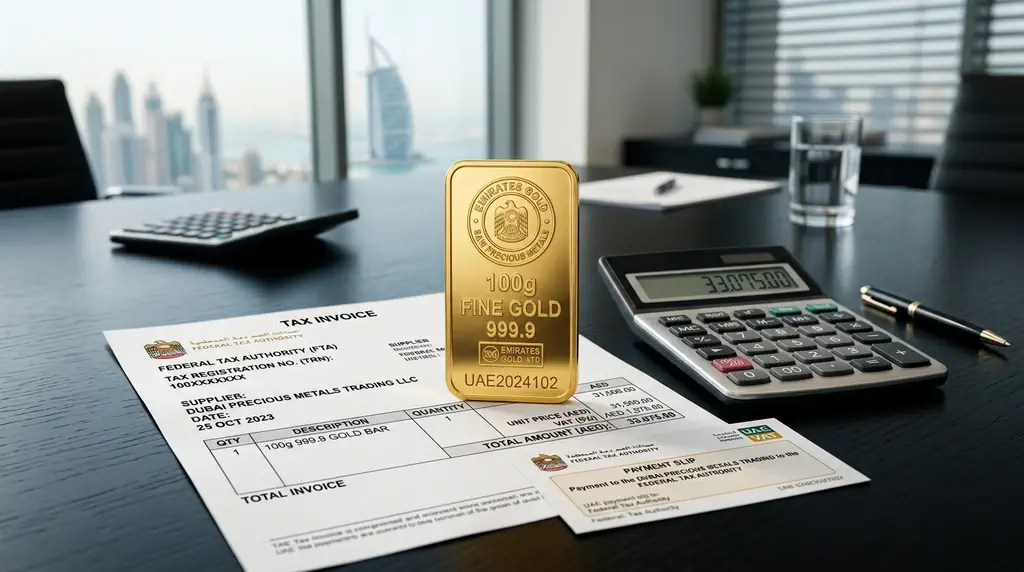
Two practical consequences follow. First, because a zero-rated sale is still a taxable supply, your dealer should hand you a proper tax invoice carrying their Tax Registration Number and showing the supply at 0% — not an invoice that simply stays silent on VAT. Second, because nothing was charged, there is nothing to reclaim later. Hold on to that second point; it comes back when we get to the airport.
The entire test is two lines long, and nobody has rewritten it since 2017
The zero rate for gold comes from one clause of the VAT law and one article of its Executive Regulation. Article 45(8) of Federal Decree-Law No. 8 of 2017 zero-rates “the supply or Import of investment precious metals”, then hands the definition downstream: “The Executive Regulation of this Decree-Law shall specify the precious metals and the standards based on which they are classified as being for investment purposes.”
Article 36 of the Executive Regulation supplies those standards, and it is short enough to read in full:
“The supply or import of investment precious metals shall be zero-rated.
The phrase ‘investment precious metals’ means gold, silver and platinum that meet the following standards:
a. The metal is of a purity of 99 percent or more.
b. The metal is in a form tradeable in global bullion markets.”
Notice what the list does not contain. Palladium is absent — it can be caught by the dealers’ reverse charge discussed further down, but it can never be zero-rated as an investment precious metal, because it is not one of the three metals named. The drafting is literal, and reading it literally is the only safe way to read it.
Notice also what the clause says nothing about: you. There is no condition about the buyer’s residency, nationality, visa status, or VAT registration. The conditions attach to the metal. A resident, a tourist and a registered trader buying the same sealed bar are all buying a zero-rated supply.
VAT on gold bars in Dubai
Line one: 99% purity, which no karat mark below 24 reaches
The threshold is 99%, expressed in the law as a percentage rather than a fineness. Converted, that is 990 parts per thousand. Everything commonly sold as investment bullion sits comfortably above it: 999.9 (99.99%) is the standard for modern minted bars, and the 999.0 (99.9%) stamp you will find on ten tola bars clears it too.
Everything in the jewellery karat ladder sits below it. 22K is roughly 91.7% gold, 21K is 87.5%, 18K is 75%. None of them are close. If you want the full ladder, our gold purity chart sets out the karat-to-fineness conversions, and 24K vs 22K gold explains why the Gulf retail market standardised on 22K in the first place.
Line two: “a form tradeable in global bullion markets” — the condition with no published list
This is the clause that does the real work, and it is the one every competing article skates over. The FTA has not published a list of approved shapes, serial formats or brands. So the honest answer is that “tradeable in global bullion markets” is a standard, not a catalogue, and you satisfy it with evidence rather than with a claim.
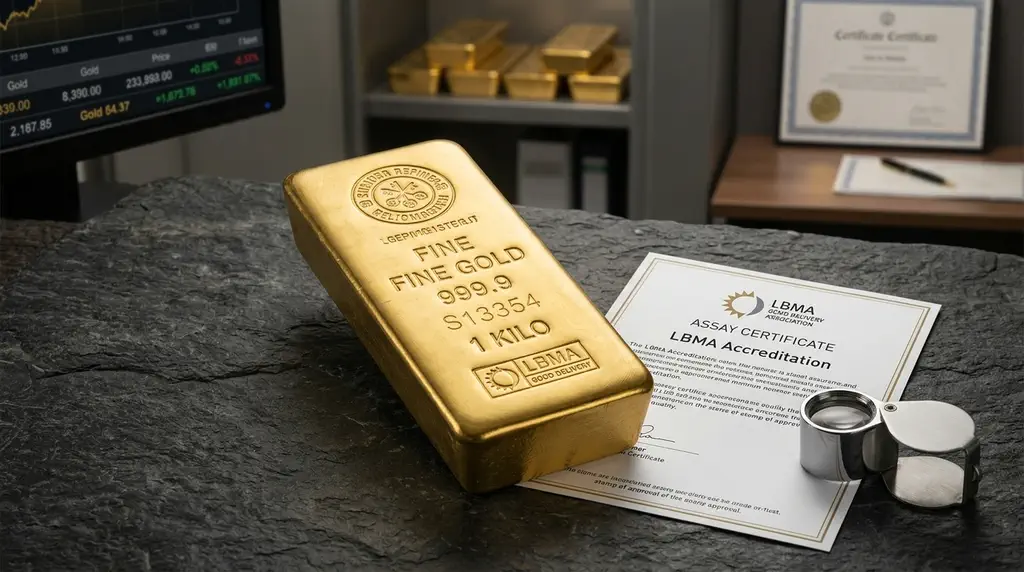
The strongest available evidence is the refiner. The LBMA’s Good Delivery technical specifications set the wholesale benchmark for the London market — a minimum fineness of 995.0 for gold and a bar of 350 to 430 fine troy ounces, carrying a serial number, the refiner’s stamp and the fineness. No retail bar is a Good Delivery bar; a 10-gram bar is nowhere near 350 ounces. What carries over to retail is the refiner’s accreditation: a bar made by a refiner on the Good Delivery List, in that refiner’s standard investment format, with an intact assay card and a matching serial, is about as defensible a “tradeable form” as a retail product gets. We have written separately on what LBMA accreditation actually means.
Where the clause gets genuinely uncertain is at the edges: heavily designed collectible pieces, limited-edition novelty bars, and anything priced well above its metal content. The purity may be perfect and the form still arguable. If that is what you are buying, ask the seller to state the VAT treatment on the invoice before you pay, rather than assuming it.
Put your purchase through the test
Both conditions have to be met. One out of two is a 5% supply.
| Product | Purity | 99%+? | Bullion-market form? | VAT |
|---|---|---|---|---|
| Sealed 999.9 gold bar, accredited refiner | 99.99% | Yes | Yes | 0% |
| 999.0 gold bar (e.g. ten tola) | 99.9% | Yes | Yes | 0% |
| 999 silver bar | 99.9% | Yes | Yes | 0% |
| Platinum bullion bar, 999.5 | 99.95% | Yes | Yes | 0% |
| 999.9 bullion coin (Maple Leaf, Philharmonic, Britannia, Buffalo, Kangaroo) | 99.99% | Yes | Yes | 0% |
| Krugerrand or American Gold Eagle | 91.67% | No | — | 5% |
| 24K gold chain, ring or pendant | 99.9% | Yes | No — it is jewellery | 5% |
| 22K / 21K / 18K jewellery | 91.7% / 87.5% / 75% | No | — | 5% |
| Sterling silver (925) | 92.5% | No | — | 5% |
| Palladium bullion | 99.95% | Yes | Not one of the three metals in Article 36 | 5% |
| Scrap gold and cut pieces | Varies | Sometimes | No standard bullion form | 5% |
| Collectible or novelty minted piece at a large premium | Often 99.99% | Yes | Arguable — ask the seller | Get it in writing |
The 24-karat chain problem: pure enough, wrong shape
Here is the case that trips up the most people, and the one that shows why the two conditions are separate.
A 24-karat gold chain is 999.9 fine. It clears the purity threshold without argument. It is still a standard-rated supply at 5%, because the second condition asks about the form the metal is in, and a chain is not a form traded on a bullion market. Nobody quotes, clears or settles chains in London or Zurich. They are manufactured goods made of very pure gold, which is a different thing from bullion. Our own 24K gold chains sit on that side of the line, and the invoice reflects it.
is gold VAT free in the UAE
The same logic explains why high purity alone never settles the question, and it is why the FTA has had to deal separately with making charges. The FTA’s public clarification on gold making charges draws the line at whether the metal and the work form a single composite supply: where the price is not split and the same supplier provides both, the making charge follows the gold; where the making charge is separately identifiable on the invoice, it is treated as its own supply and VAT applies to it. For a bullion buyer, the lesson is narrow but worth money — if your bar comes with a separately priced box, engraving or design service, that line can carry 5% even when the metal line carries 0%.
Two of the world’s best-known gold coins fail on purity
Gold coins are the category where confident guessing goes wrong most often, because the famous names are not the pure ones.
The South African Krugerrand and the American Gold Eagle are both 22-karat coins, .9167 fine. Each contains a full troy ounce of gold, which is why they feel like bullion — but the alloy is deliberately hardened with copper and silver, and 91.67% is nowhere near 99%. On the UAE test they are standard-rated, however globally traded they are.
The .9999 coins clear it easily: the Canadian Gold Maple Leaf, the Austrian Philharmonic, the Royal Mint’s Gold Britannia, the American Gold Buffalo and the Australian Kangaroo are all four-nines fine. Our gold coins page lists what we actually hold, and which gold coin brand is best compares them on grounds other than tax.
One more point for collectors: a coin can clear 99% purity and still raise the form question if it is sold as a numismatic or commemorative item at a multiple of its metal value. Purity and premium are separate issues.
Residents pay 0%, tourists pay 0%, and that is why there is no refund to claim
“Can tourists buy investment gold VAT-free in Dubai?” is one of the most searched versions of this question, and the answer is a little counter-intuitive: yes — and so can everyone else, which is exactly why there is nothing waiting for you at the airport.
The VAT Refund Scheme for Tourists is run by the Federal Tax Authority with Planet as its service provider, and it refunds VAT that was actually charged. On a zero-rated bar, no VAT was charged. There is no refundable amount, no tax-free tag, and nothing to validate on departure. A tourist buying a sealed 999.9 bar and a UAE resident buying the same bar pay the same price, and neither of them is leaving anything on the table.
Where the scheme does matter is on the 5% side of the line — jewellery, watches, and the designed pieces people buy in the Souk. The FTA’s published conditions are specific: you must be 18 or over, not a UAE resident, and have entered on a tourist visa; the minimum is AED 250 per refund transaction, exclusive of VAT; transactions must be validated within 90 days of the tax invoice date; you must leave the UAE within 6 hours of completing validation or the approval is cancelled; the refund must be requested within one year of export validation; and the deduction is 13% of the VAT amount plus AED 3.60 per tax-free transaction, with cash refunds capped at AED 35,000.
So if your plan is to buy jewellery and claim the VAT back, the scheme is real and worth using. If your plan is to buy bullion, the scheme is irrelevant — and that is the better outcome, because you never paid the tax in the first place. If you are weighing Dubai against prices at home, whether gold is actually cheaper in Dubai looks at the premium rather than the tax.
The reverse charge is a dealers’ rule. A consumer purchase never reaches it.
Search for VAT on gold in the UAE and most of what comes back is about the reverse charge mechanism. If you are an individual buying metal for yourself, almost none of it applies to you — and it is worth knowing why, so you can ignore it with confidence.
VAT on gold bars in UAE / Dubai
Cabinet Decision No. 127 of 2024 widened the domestic reverse charge for precious goods. It was published in the Official Gazette on 27 December 2024, took effect 60 days later in late February 2025, and repealed the older Cabinet Decision No. 25 of 2018, which had covered only gold and diamonds. The new scope is broader: gold, silver, palladium and platinum; natural and manufactured diamonds, pearls, rubies, sapphires and emeralds; and jewellery made from them, where the value of the precious component exceeds the value of the other materials. The FTA then issued public clarification VATP043 in April 2025 to explain how it works in practice.
What the mechanism does is move the obligation to account for VAT from the seller to the buyer. It applies only when the buyer is VAT-registered in the UAE, the goods are bought for resale or for manufacturing, and the buyer gives the seller written declarations to that effect before the date of supply. The seller has to verify the buyer’s registration and keep the declarations; if the declarations are missing, the mechanism does not apply and the seller charges VAT normally.
Two things follow. First, a retail buyer has no Tax Registration Number and is not buying for resale, so the conditions can never be met — your purchase is simply a 0% supply or a 5% supply, with no reverse charge in sight. Second, and less widely understood: the reverse charge and the zero rate are alternatives, not layers. If the bar is investment-grade, the supply is already at 0% and there is no VAT to shift onto anyone. The reverse charge matters for the gold that isn’t investment-grade — jewellery, scrap, 22K stock moving between registered traders.
What the 2026 amendments changed, article by article
Plenty of articles carry “2026” in the title and then cite nothing from 2026. There were in fact two substantial sets of amendments, and between them they touched thirteen provisions. Here is the complete list, and where investment gold sits in it.
1 January 2026 — Federal Decree-Law No. 16 of 2025
Issued 25 November 2025 and effective 1 January 2026, this amended the VAT law itself in four places:
- Article 48(1) — businesses no longer have to issue self-invoices for reverse-charge imports.
- Article 54 — the FTA may deny input tax recovery where a supply is linked to a tax evasion chain and the taxpayer knew or should have known, and taxpayers must verify the integrity of supplies before recovering input tax.
- Article 74(3) — excess recoverable input tax can be carried forward for five years, after which it lapses.
- Article 79 bis — repealed; limitation periods now follow the Tax Procedures Law.
Article 45, which carries the zero rate for investment precious metals, is not on that list.
14 January 2026 — scrap metal joins the reverse charge
Cabinet Decision No. 153 of 2025 brought scrap metal transactions between VAT-registered businesses into the reverse charge from 14 January 2026, with the same declaration-and-verification pattern. Precious metals were already covered by the 2024 decision, so nothing changed for gold. Like every reverse-charge rule, it applies only between registered businesses.

UAE gold VAT rules 2026
1 October 2026 — Cabinet Decision No. 149 of 2026
This is the big one. Issued 1 September 2026 and announced by the Ministry of Finance, it amended nine provisions of the VAT Executive Regulation with effect from 1 October 2026: Article 4(6) on composite supplies, Article 29(5) on the Profit Margin Scheme, Article 41(4) on medical products, Article 52(2) on when a person is “outside the State”, Article 53(1)(c) on employee benefits, Article 54(3) on cash payments, Article 55 on input tax apportionment, Article 57(1) on capital assets, and Article 60(1)(a) on tax credit notes. The input tax apportionment changes run from the first tax year beginning after 1 October 2027.
Article 36 is not among them. The two-line definition of investment precious metals that was written in 2017 is still the operative text in 2026.
One of the nine does brush against gold, though, and it is worth flagging: the Article 4(6) change on composite supplies treats economically inseparable bundled elements as a single supply taxed at the rate of the principal component. For anyone selling metal together with design, packaging or making services, that is the rule that decides whether the whole thing follows the metal or splits into separate lines.
From July 2026 — e-invoicing starts its pilot
The UAE’s e-invoicing regime, built on Ministerial Decisions No. 243 and 244 of 2025 and No. 66 of 2026, begins its pilot in July 2026, with mandatory go-live on 1 January 2027 for businesses at or above AED 50 million in revenue and 1 July 2027 for the rest. Business-to-consumer transactions are outside the scope for now. It changes how invoices are transmitted, not what rate applies to them — and it does not change the 0% on your bar.
Five checks before you pay
- Read the stamp, not the sales patter. 999.9 or 999.0 clears the purity line. Anything carrying a karat mark below 24 does not, no matter how it is described.
- Ask for a tax invoice, not a receipt. It should carry the seller’s Tax Registration Number and show the supply at 0% as a zero-rated supply. Silence on VAT is not the same as 0%, and you will want the paperwork if you ever resell or export.
- Check who refined it. A bar from a refiner on the LBMA Good Delivery List, in that refiner’s standard investment format, is the cleanest evidence that the metal is in a form traded on global bullion markets.
- Keep the seal and match the serial. The assay card is part of the product, not packaging. Here is how to check a gold bar serial number before you accept delivery.
- Watch the extra lines. Separately priced engraving, presentation cases, design work or making charges can attract 5% even when the metal itself is at 0%.
If you are buying to hold, the two questions that follow a purchase are how you would exit it and how you would move it. We cover both: selling gold and silver back, and exporting gold from Dubai, where a zero-rated export is a separate provision from the investment-metals one.
Where to go from here
If you have read this far, the useful takeaway is narrow and durable: in the UAE, the tax question about gold is a question about purity and form, and it has had the same two-line answer since the day VAT started. Nothing in 2026 moved it.
Our gold bars and silver bars are investment-grade, sealed and serial-matched, from refiners on the LBMA Good Delivery List — including PAMP gold bars — and every one of them invoices as a zero-rated supply with our TRN on the document. If you want the treatment of a specific product confirmed before you buy, ask us and we will put it in writing.
General information, not tax advice. This article explains published UAE legislation and official guidance as at November 2026, with sources linked so you can verify each point. It is not personalised tax or legal advice, and it cannot account for your own circumstances. For a position you intend to rely on, consult a registered tax agent or the Federal Tax Authority directly. Where published commentary differs on a date — the effective date of Cabinet Decision No. 127 of 2024 is cited variously as 25 and 26 February 2025 — we have said so rather than picking one silently.
Frequently Asked Questions
Is investment gold VAT-free in the UAE in 2026?
It is zero-rated, which means VAT applies at 0% rather than not applying at all. Gold qualifies when it is 99% pure or better and in a form tradeable in global bullion markets, under Article 45(8) of Federal Decree-Law No. 8 of 2017 and Article 36 of its Executive Regulation. Neither provision was amended by the 2026 changes.
Is there VAT on gold bars in Dubai?
Not on investment-grade bars. A sealed 999.9 bar from an accredited refiner is a zero-rated supply, so the price you pay is the metal plus the dealer's premium, with no 5% on top. A bar that fails either condition — low purity, or a form that is not a bullion-market form — is standard-rated at 5%.
Does 999.9 gold qualify for 0% VAT in the UAE?
999.9 clears the purity condition by a wide margin. It still has to clear the second one: the metal must be in a form tradeable in global bullion markets. A 999.9 bar does; a 999.9 chain does not.
Is 22K gold subject to VAT?
Yes, at 5%. 22K is about 91.7% gold, which is below the 99% threshold. The same applies to 21K and 18K. Purity is assessed as the law states it, not by how the piece is marketed.
Is gold jewellery VAT-free in Dubai?
No. Jewellery is standard-rated at 5%, including 24K jewellery, because jewellery is not a form traded on global bullion markets even when the metal is pure. Where a making charge is billed as a separate, identifiable line, it is treated as its own supply.
Are gold coins VAT-free in the UAE?
It depends entirely on the coin. 999.9 coins such as the Canadian Maple Leaf, Austrian Philharmonic, Gold Britannia, American Buffalo and Australian Kangaroo clear the 99% threshold. The Krugerrand and the American Gold Eagle are 22-karat, .9167 fine, and do not. Coins sold as collectibles at a large premium over metal value can also raise the question of form.
Is zero-rated VAT the same as VAT-exempt?
No. A zero-rated supply is taxable at 0% and the seller can still recover input VAT on related costs, subject to the usual rules. An exempt supply is outside the tax and carries no input tax recovery. Investment precious metals are zero-rated under Article 45; they are not in the exempt list in Article 46.
Can tourists buy investment gold VAT-free in Dubai?
Yes — and so can residents, because the zero rate attaches to the metal, not to the buyer. That also means there is no tourist refund to claim on a bullion purchase: the Tourist Refund Scheme returns VAT that was charged, and on a zero-rated bar none was. The scheme is relevant to jewellery and watches bought at 5%.
Does the 0% rate apply to buying gold online in the UAE?
The rate follows the product and the supply, not the sales channel. An investment-grade bar bought online from a UAE-based dealer is the same zero-rated supply as one bought over a counter, and you should receive the same tax invoice showing 0%.
How do I check whether a product qualifies as investment gold?
Three things, in order: the purity stamp (99% or better), the refiner and format (an accredited refiner's standard investment product, sealed, with a matching serial), and the invoice (0% stated as a zero-rated supply, with the seller's TRN). If a seller cannot or will not put the treatment on the invoice, treat that as the answer.