Where to Buy Gold Bars in Dubai? Most guides to buying gold in Dubai are written by people who have never sold a gram of it. They describe the Gold Souk as a tourist attraction, talk about bargaining over making charges, and never mention that jewellery and investment bullion are two completely different purchases.
This guide is written from the other side of the counter. We trade bullion from the Gold Souk in Deira, so we will tell you honestly what each buying channel is good at — including the times when you should not buy from a dealer like us.
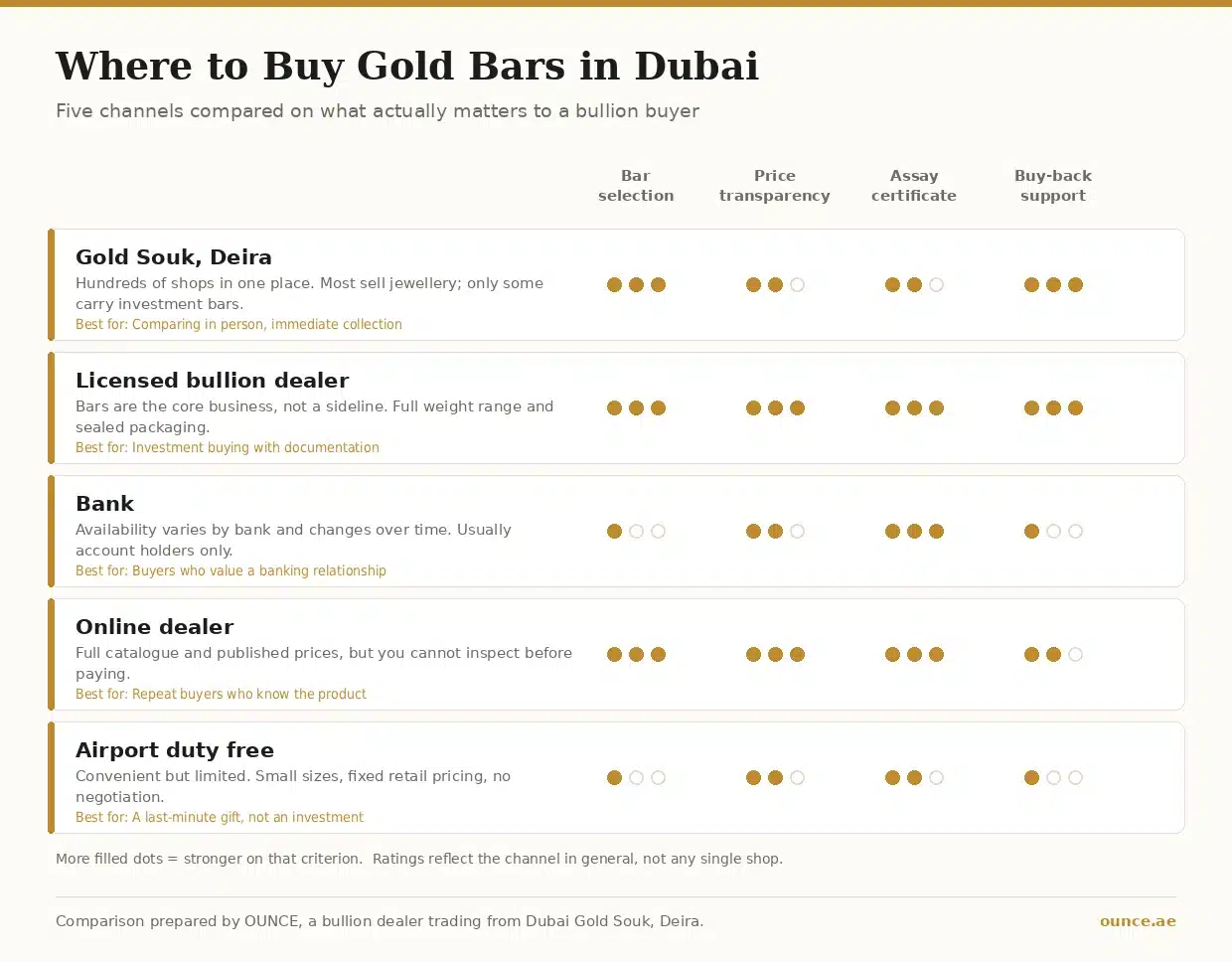
The five places you can buy gold bars in Dubai
Before comparing them, one distinction matters more than anything else in this article.
Investment bullion is not jewellery. A gold bar is priced on its metal content plus a small refining premium. Jewellery is priced on metal content plus a making charge that can run from 10 to 50 dirhams per gram, and that making charge is largely lost when you sell. Most of the shops you see in the Gold Souk sell jewellery. Only a portion of them deal in investment bars.
If your goal is to hold gold as an asset, you are shopping for a much smaller set of sellers than the crowds in Deira suggest. That single fact changes where you should go.
Buying at the Gold Souk in Deira
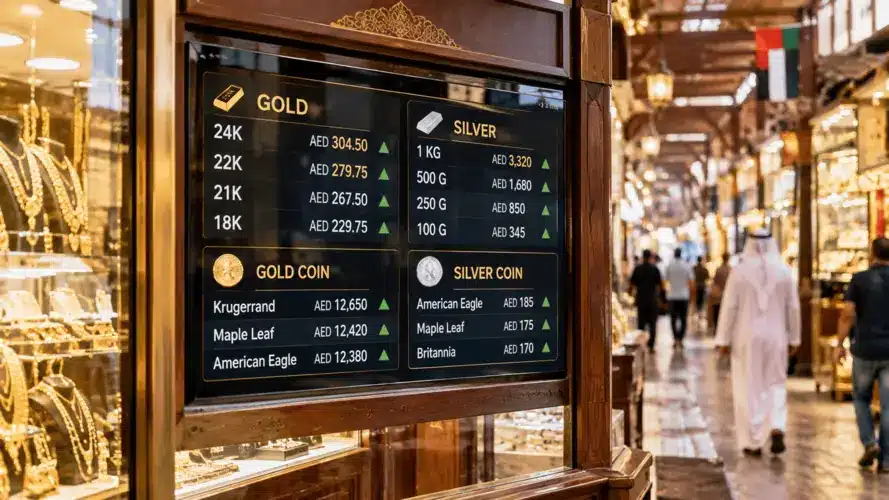
The Gold Souk in Al Ras, Deira, is the densest concentration of gold sellers anywhere in the region — more than 300 shops in a few connected lanes, served by the Al Ras and Gold Souq stations on the Green Line.
What it does well. Nowhere else lets you compare this many sellers in an afternoon, hold the product before paying, and take it home the same day. If a bar looks wrong, you can put it down and walk to the next shop. That is a real advantage that no website replicates.
Where it gets harder. The souk is built around jewellery retail, and most window displays reflect that. Finding a shop with a full range of sealed investment bars — 1 gram through 1 kilogram, several refineries, every bar with its assay card — takes knowing where to go. Shops that do carry bars often keep a limited selection of sizes.
Pricing is also less standardised than visitors expect. The gold rate itself is effectively fixed across the market, but the premium above it is not, and it is rarely displayed. Two shops fifty metres apart can quote noticeably different figures for the same 10 gram bar.
Practical tip: ask any souk seller to break the price into two numbers — the gold value and the premium. A seller who quotes only a single total is not necessarily overcharging, but you have no way to compare them against anyone else.
If you want the market’s history and layout rather than its buying mechanics, we cover that separately in our guide to the Dubai Gold Souk.
Buying from a licensed bullion dealer
A bullion dealer is a different business from a jewellery shop that happens to stock bars. Bullion is the core product, so the range is deeper, the packaging is consistent, and the documentation is standard rather than something you have to request.
Licensed dealers operate both inside the Gold Souk and in the DMCC free zone in Jumeirah Lakes Towers, which is where much of the UAE’s wholesale precious metals trade is based.
What you should expect from any dealer worth using:
- A full weight range, typically 1 g, 2.5 g, 5 g, 10 g, 20 g, 1 oz, 50 g, 100 g, 250 g, 500 g and 1 kg
- Traditional Tola formats, including the 10 Tola or TT bar at 116.64 grams, which remains one of the most liquid bars in the local market
- Recognised refiners such as PAMP Suisse, Valcambi, Emirates Gold, Emirates Minting and Al Etihad
- Every bar sealed with its assay certificate
- A price quoted as gold value plus premium, not a single opaque figure
- A stated buy-back position, so you know what happens when you want to sell
The trade-off. Dealers are not tourist attractions. There is no bargaining theatre and no crowd. If you enjoy the experience of the souk, buying from a bullion counter will feel comparatively plain. What you gain is documentation and range.
Buying gold bars from a bank
Some UAE banks offer gold bars to their account holders. Availability changes over time and varies between institutions, so treat any list you read online — including this one — as something to verify directly with your own bank.
What it does well. For buyers who want the transaction to sit inside an existing banking relationship, this is the most familiar route. Documentation is thorough and the chain of custody is clear.
Where it falls short. The selection is usually narrow, often a handful of sizes from a single refinery. Pricing tends to be less competitive than a specialist dealer’s, because bullion is a peripheral service rather than the main business. Most importantly, banks generally do not buy gold back. When you want to sell, you will be going to a dealer anyway.
That last point is the one most first-time buyers overlook. A purchase is only half a transaction. Where you will sell matters as much as where you buy.
Buying gold bars online in the UAE
Online bullion dealers publish their catalogue and their prices, which removes the biggest friction of the souk: you can compare before you leave the house.
What it does well. Full weight and refinery range with nothing hidden behind a counter. Written product specifications. Prices you can check against the market before committing. Delivery across the UAE, often same day.
Where it falls short. You cannot inspect the bar before paying. For a first purchase, that matters more than people expect — there is something clarifying about holding a sealed 100 gram bar before you commit to one.
How to reduce that risk: buy from a dealer that also has a physical location you could visit. A website with no address, no landline and no named people behind it is a different proposition from an online storefront run by a shop you can walk into.
If you are buying online, our gold bar collection shows specifications, refiner and packaging for every bar.
Buying gold at Dubai airport duty free
You can buy small gold bars at Dubai International, and for a departing traveller who forgot a gift, that convenience is real.
For investment it is the weakest option on this list. Selection is limited to small sizes, pricing is fixed retail with no room to compare, and you are buying at the point of least leverage. If you are in Dubai for three days and gold is on your list, spend an hour in Deira instead of ten minutes at the gate.
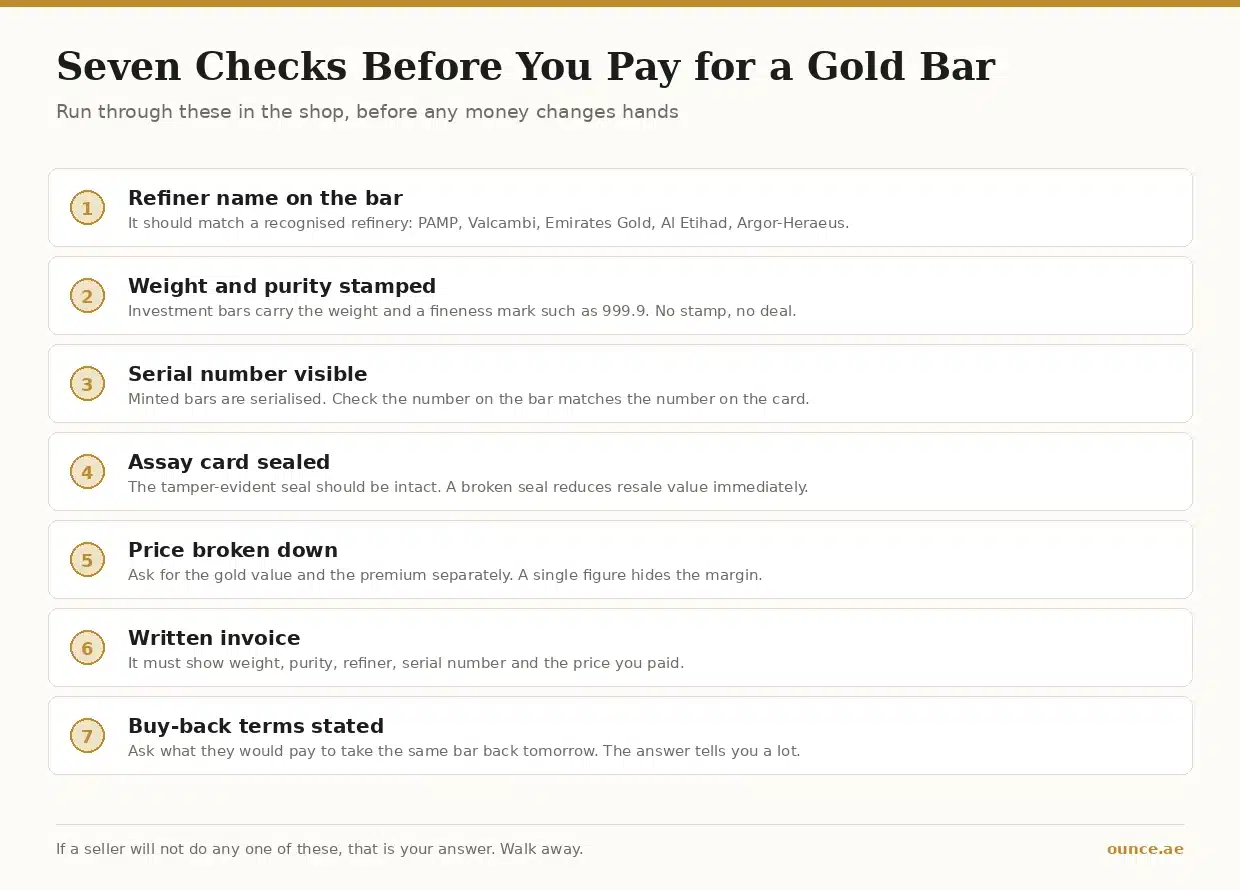
Seven checks before you pay
These apply wherever you buy. Run through them before any money changes hands.
1. The refiner name is on the bar. It should be a refinery you can look up: PAMP Suisse, Valcambi, Argor-Heraeus, Emirates Gold, Emirates Minting, Al Etihad. An unbranded bar is not automatically fake, but it is much harder to resell.
2. Weight and purity are stamped into the metal. Investment bars carry both. Look for a fineness mark — 999.9 on most modern bars, 999.0 on many Tola and TT bars. Both are investment grade; they are simply different standards.
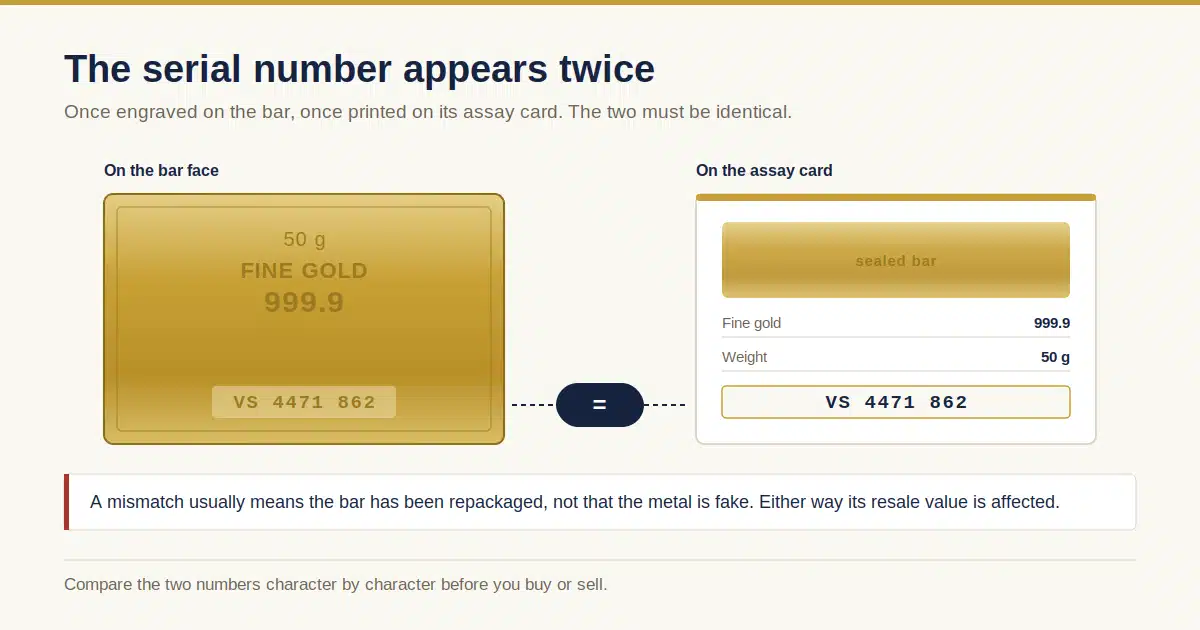
3. There is a serial number, and it matches. Minted bars are serialised. The number stamped on the bar should match the number printed on the assay card. Check it yourself rather than taking anyone’s word for it.
4. The assay card seal is intact. The tamper-evident seal is not packaging, it is part of the product’s value. A bar removed from its sealed card usually resells for less, because the next buyer has to re-verify it.
5. The price comes apart into two numbers. Gold value and premium, stated separately. This is the single most useful question you can ask, and the reaction to it tells you almost as much as the answer.
6. You get a written invoice. It should show weight, purity, refiner, serial number and the price paid. If you ever sell, insure or export the bar, you will need it.
7. You know the buy-back position. Ask what the seller would pay to take the same bar back tomorrow. Nobody buys back at the price they sold — the gap is how dealers earn — but a seller who cannot answer at all is telling you they do not really deal in bullion.
For the specific mechanics of checking serial numbers and refiner verification tools, see our detailed guide on how to check a gold bar serial number.
What the law requires from a seller in the UAE
This section is not in any travel guide, and it is one of the more useful things a buyer can know.
Dealers in precious metals and stones in the UAE are classified as Designated Non-Financial Businesses and Professions. Under Federal Decree-Law No. 10 of 2025 and Cabinet Resolution No. 134 of 2025, a single cash transaction — or several linked transactions — at or above AED 55,000 triggers mandatory customer due diligence and a report to the UAE Financial Intelligence Unit.
What this means for you as a buyer. Above that threshold, a compliant dealer will ask for identification and may ask about the source of funds. That is not suspicion, it is the law. A seller who offers to structure a large purchase into smaller cash payments to stay under the threshold is offering to break it, and you do not want to be part of that transaction.
Below AED 55,000, the reporting requirement does not automatically apply, though dealers still operate risk-based checks.
Buying gold bars in Dubai as a visitor
Tax. Investment-grade gold of 99% purity or higher is zero-rated for VAT in the UAE, which covers essentially every 999.9 bar sold as bullion. The standard 5% VAT applies to jewellery and to some collectible or gift-packaged items. There is no capital gains tax on precious metals in the UAE.
Currency. The dirham has been pegged to the US dollar at 3.6725 since 1997, so gold prices in Dubai track the international market directly rather than moving with local currency swings. This is worth understanding before assuming Dubai is simply “cheaper” — the metal costs the same everywhere. What differs is tax treatment and the premium, not the gold.
Taking it home. Two separate rules apply, and people confuse them constantly.
Leaving the UAE, travellers carrying currency, precious metals or precious stones above AED 60,000 in value must complete a customs declaration. This is a declaration, not a tax.
Arriving in your destination country, that country’s own rules apply. India in particular charges customs duty on gold brought in by passengers, and the allowance for bullion differs from the allowance for jewellery. Check the current rules for your destination before you fly, not at the airport.
Our guide on exporting gold from Dubai covers the documentation side in more detail.
Four mistakes we see most often
Buying jewellery when you wanted an investment. A 22K chain and a 999.9 bar are not interchangeable. The chain carries a making charge you will not recover.
Breaking the seal to look at the bar. Once the assay card is opened, the bar’s resale value drops. Examine it through the packaging. Every check in the list above can be done without breaking anything.
Assuming the biggest bar is the best value. A kilo bar has the lowest premium per gram, which is true and often quoted. What is quoted less often is that you cannot sell a third of it. For most private buyers, several 100 gram bars are more useful than one kilo bar, and the extra premium is the price of that flexibility. We look at this trade-off in more detail in gold bars vs gold coins.
Not asking where you will sell. Buying is the easy half. Before you pay, know who buys this specific bar back, and roughly on what terms.
Where we fit
We are a bullion dealer trading from the Dubai Gold Souk in Deira, and we sell online across the UAE. We stock 999.9 gold bars from 1 gram to 1 kilogram, from PAMP Suisse, Emirates Gold, Valcambi, Emirates Minting, Al Etihad and other recognised refiners, and we quote gold value and premium separately.
We are not the right choice for everyone. If you want 22K jewellery, a jeweller will serve you better than we will. If you want a single small bar as a gift and you are already at the airport, buy it there — the difference will not be worth the trip. And if you are placing a wholesale-scale order, that is a different conversation from a retail purchase.
If you want to see what is in stock, browse our gold bars or silver bars, or get in touch and ask us anything on this list.
Frequently Asked Questions
Where is the best place to buy gold bars in Dubai?
It depends on what you value. For the widest choice of sealed investment bars with full documentation, a licensed bullion dealer is the strongest option. For comparing many sellers in person on the same day, the Gold Souk in Deira is unmatched. For convenience and published pricing, an online dealer with a physical location behind it.
Can tourists buy gold bars in Dubai?
Yes. There is no residency requirement to buy gold in the UAE. Bring your passport, since identification is required for larger transactions, and check your destination country's import rules before you travel home.
Is it cheaper to buy gold bars in Dubai?
The gold itself costs the same everywhere, because it is priced on a single global market. Dubai's advantage is that investment bullion is VAT-exempt, there is no capital gains tax, and competition between hundreds of sellers keeps premiums tight. Those things are real, but they are not the same as a lower gold price.
How do I know a gold bar is real?
Check the refiner name, the stamped weight and purity, the serial number against the assay card, and that the tamper seal is intact. Buying from an established dealer who will also buy the bar back is itself a meaningful check, because a dealer's willingness to repurchase is a statement about what they sold you.
What is a TT bar and should I buy one?
A TT bar is the local name for a 10 Tola gold bar, weighing 116.64 grams. It is a traditional format across the UAE, India and Pakistan and is one of the most liquid bars in the Deira market. If you expect to sell locally, its familiarity is an advantage. If you expect to sell internationally, a standard gram-denominated bar from an LBMA refiner travels better.
Do I need to pay VAT on a gold bar in Dubai?
Investment-grade gold of 99% purity or above is zero-rated for VAT in the UAE. The standard 5% applies to jewellery and to some collectible items. Confirm the VAT status of the specific product before you buy.
Can I buy gold bars in Dubai with cash?
Yes, but transactions at or above AED 55,000 in cash trigger mandatory identification and reporting requirements for the dealer under UAE anti-money-laundering law. Expect to show ID. A seller willing to split a large purchase to avoid this is not one to use.
How much gold can I take out of Dubai?
There is no limit on how much gold you may own or carry, but travellers leaving the UAE with currency or precious metals valued above AED 60,000 must complete a customs declaration. Your destination country will apply its own import rules and duties on top of that.