

The Gold Purity PDF is available at the end of this article.
What Is a Gold Purity Chart? (Karat vs Fineness Explained for Investors)
Introduction
When buying gold, one of the most important — and often misunderstood — factors is purity.
You may see numbers like 24K, 22K, 18K, or stamps such as 999 and 999.9 engraved on a gold bar.
But what do these actually mean? And more importantly — which one should you buy if your goal is investment rather than jewelry?
A gold purity chart helps translate these numbers into something practical. It shows how much real gold is inside an item, expressed either in karats or in fineness (percentage form).
Understanding this is not just technical knowledge — it directly affects resale value, liquidity, and long-term wealth preservation.
Why Gold Purity Matters More Than Most People Think
Gold is a financial asset. And like any financial asset, its value depends on measurable standards.
Pure gold is soft. Extremely soft. That’s why jewelry is often mixed with other metals. But investment gold is different. Investors prioritize purity because:
Higher purity means stronger resale demand.
International buyers prefer standardized grades.
Certified bullion is easier to trade globally.
If you plan to hold gold as a store of value, purity becomes more important than design.

Karat (K) Explained in Simple Terms
The karat system measures gold in parts out of 24.
24K means 24 out of 24 parts are gold — essentially pure gold.
22K means 22 parts gold and 2 parts other metals.
18K means 18 parts gold and 6 parts other metals.
In jewelry markets, especially in regions like the Middle East and South Asia, 22K is common because it balances durability with high gold content.
However, for investment purposes, 24K is usually preferred because it represents the highest gold concentration.
Fineness: The Language of Bullion Investors
While jewelry uses karats, bullion markets use “fineness.”
Fineness expresses gold purity in parts per thousand.
So instead of 24 parts, it’s measured out of 1000.
A stamp of:
- 999 means 99.9% pure gold
- 999.9 means 99.99% pure gold
Most internationally recognized bullion bars — including those produced by
PAMP Suisse —
are refined to 999.9 purity.
This level has become the global standard for investment-grade gold.

Gold Purity Chart (Karat to Percentage Conversion)
Here is a simple conversion reference you can include in your article:
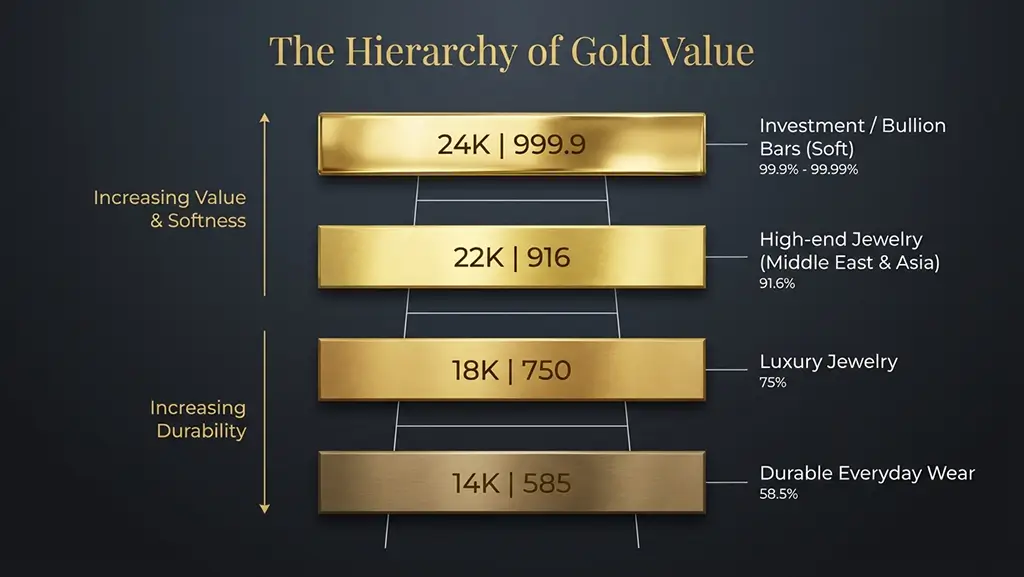
| Karat (K) | Gold Content (%) | Fineness Mark | Common Use |
|---|---|---|---|
| 24K | 99.9% – 99.99% | 999 / 999.9 | Bullion / Investment Bars |
| 22K | 91.6% | 916 | High-end Jewelry |
| 18K | 75% | 750 | Luxury Jewelry |
| 14K | 58.5% | 585 | Durable Everyday Jewelry |
999 vs 999.9 — Is There a Real Difference?
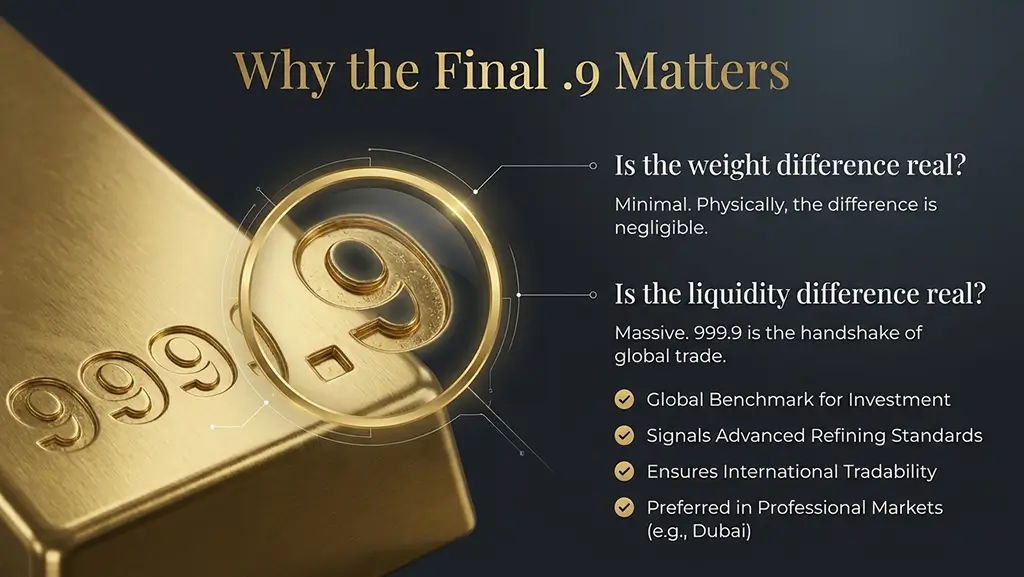
From a practical standpoint, the difference between 99.9% and 99.99% gold is minimal in weight.
However, 999.9 has become the global benchmark for investment bullion.
It signals:
- Advanced refining standards
- International tradability
- Higher investor confidence
In professional markets like Dubai’s bullion trade, 999.9 is widely preferred for liquidity.
How to Read Gold Stamps Correctly
When buying gold, always look for:
- Purity stamp (999 / 999.9 / 750 etc.)
- Weight marking (e.g., 1 oz, 10g)
- Refiner logo
- Assay certification
A sealed bullion bar with serial number and assay card provides additional security and resale confidence.
Which Gold Purity Should Investors Choose?
If your goal is:
Jewelry for style → 18K or 22K is common.
Wealth preservation or portfolio diversification → 999 or 999.9 bullion is typically the better option.
Investment-grade purity ensures stronger global demand and easier resale — especially in major markets such as Dubai.
Final Thoughts
A gold purity chart is more than just a technical reference.
It helps buyers make informed decisions, avoid overpaying for lower purity, and understand what they are truly purchasing.
For serious investors, clarity on purity is the foundation of smart gold ownership.
Download Gold Purity Chart PDF
Frequently Asked Questions
What is a Gold Purity Chart?
A Gold Purity Chart is a simple reference that shows how much pure gold is contained in a gold bar, coin, or jewelry item. It usually compares karat values such as 24K, 22K, and 18K with fineness numbers like 999, 916, and 750. This helps buyers quickly understand the purity level, compare different gold products, and make better investment or purchasing decisions.
Which gold purity is best for investment?
Most investors prefer higher purity gold such as 24K, 999, or 999.9 gold bars. These purity levels are widely accepted in global markets and are commonly used for investment-grade bullion. Higher purity gold is also easier to price, compare, and resell, making it a practical choice for long-term wealth preservation.
What is the difference between 24K, 22K, and 18K gold?
The main difference is the amount of pure gold.
24K gold contains about 99.9% pure gold and is mainly used for investment bars and coins.
22K gold (916) contains 91.6% gold and is commonly used for jewelry in many regions.
18K gold (750) contains 75% gold and is often used for luxury jewelry that requires more durability.
Understanding these differences helps buyers choose the right gold depending on whether the goal is investment, gifting, or everyday use.